


What Is a Player Wallet in iGaming? Complete Guide for Operators

A player wallet in iGaming is the system that keeps track of a player’s monetary balance and records financial transactions associated with their gambling account.
Whenever a player deposits funds, places a bet, receives winnings or makes a withdrawal, the wallet must reflect the corresponding change in balance. In modern iGaming environments, the wallet is usually closely connected with the Player Account Management system (PAM), payment infrastructure, games, sportsbook and other platform components.
For operators, however, a player wallet in iGaming is more than a number displayed next to a player’s account. It is a central transaction layer that must process balances accurately, communicate with multiple products in real time and provide reliable records for reporting, compliance and player support.
The UK Gambling Commission describes a customer account or wallet as the component that tracks the customer’s balance and transactions into and out of the account, including deposits, withdrawals and gambling transactions.
This guide explains how player wallets work, how they connect with other parts of an iGaming platform and what operators should consider when choosing a player wallet system.
How Does a Player Wallet in iGaming Work?
A player wallet in iGaming records the financial activity associated with an individual player’s account.
At the simplest level, the process looks like this:
Deposit → Wallet balance → Bet → Game result → Updated balance → Withdrawal

In practice, several systems communicate during every step.
For example, when a player places a €10 bet:
- the game or sportsbook sends a transaction request,
- the wallet verifies whether sufficient funds are available,
- €10 is reserved or deducted from the player’s balance,
- the gambling transaction takes place,
- the result is returned to the platform,
- any winnings are credited back to the wallet,
- the transaction is stored in the player’s history.
These actions may happen within fractions of a second.
A reliable player wallet in iGaming therefore needs accurate transaction processing, synchronization and communication between different platform components.
What Does an iGaming Wallet Manage?
A player wallet in iGaming may handle several types of financial activity.
These commonly include:
- deposits,
- withdrawals,
- stakes,
- winnings,
- refunds,
- transaction adjustments,
- bonus balances,
- promotional funds,
- transfers between products,
- payment-related transactions.
The wallet also creates a transaction history that allows the platform and operator to understand how funds have moved through the player account.
In regulated environments, access to this information can also be a regulatory requirement. For example, the UK Gambling Commission requires operators to provide customers with access to account and gambling transaction history, including deposits, withdrawals, bets and winnings.
Player Wallet and PAM: What Is the Connection?
A player wallet is typically one of the core components of a Player Account Management system.
PAM manages the wider relationship between the operator and the player, including:
- account registration,
- authentication,
- personal information,
- KYC,
- wallet and balances,
- bonuses,
- responsible gaming controls,
- player segmentation,
- reporting.
The wallet focuses specifically on the monetary side of that relationship.
A simple way to think about it is:
| PAM | Player Wallet |
|---|---|
| Manages the player account | Manages monetary balances |
| Stores account information | Records financial transactions |
| Handles authentication | Processes debits and credits |
| Supports KYC | Connects deposits and withdrawals |
| Manages responsible gaming controls | Tracks movement of funds |
| Connects casino, sportsbook and other products | Makes balances available to those products |
The two systems therefore work closely together.
Gaming Laboratories International also treats deposits, withdrawals and account activity statements as core elements of Player Account Management functionality.
Operators evaluating a new PAM solution should therefore assess wallet functionality as part of the overall platform architecture rather than as an isolated feature.
What Happens When a Player Deposits Money?
A deposit begins in the payment layer but ultimately affects the player’s wallet.
A typical transaction may follow this sequence:
- The player selects a payment method.
- The payment request is sent to a payment service provider.
- The transaction is authorized.
- The payment system informs the iGaming platform.
- The player’s wallet is credited.
- The updated balance becomes available for gambling.
The exact architecture depends on the operator, payment provider and platform configuration.
This distinction is important:
The payment system moves money between the player and the operator.
The wallet records and manages the player’s usable balance inside the gambling platform.
These two functions are closely connected, but they are not the same thing.
What Happens When a Player Places a Bet?
Once a player has funds in their account, games or betting products interact directly with the wallet.
Suppose a player has a balance of €100 and places a €5 casino bet.
The wallet receives a request from the game and deducts or reserves €5.
If the bet loses:
Balance: €100 → €95
If the game returns €15 in winnings:
Balance: €95 → €110
The wallet records both the original stake and the resulting win.
For operators running thousands of concurrent gaming sessions, this requires a transaction system capable of processing large volumes of requests consistently and quickly.
Single Wallet vs Multi-Wallet
One of the most important architectural decisions is whether players use a single wallet across the platform or separate balances for individual products.
What Is a Single Wallet?
A single wallet allows the player to use one balance across different gambling products.
For example:
Casino + Sportsbook + Live Casino + Poker → One Balance
A player who deposits €100 may therefore use those funds directly across multiple products without manually transferring money.
Benefits of a single wallet can include:
- simpler player experience,
- easier movement between products,
- one visible account balance,
- fewer manual wallet transfers,
- easier cross-product navigation.
For operators offering several gambling verticals, a single wallet can help create a more unified platform experience.
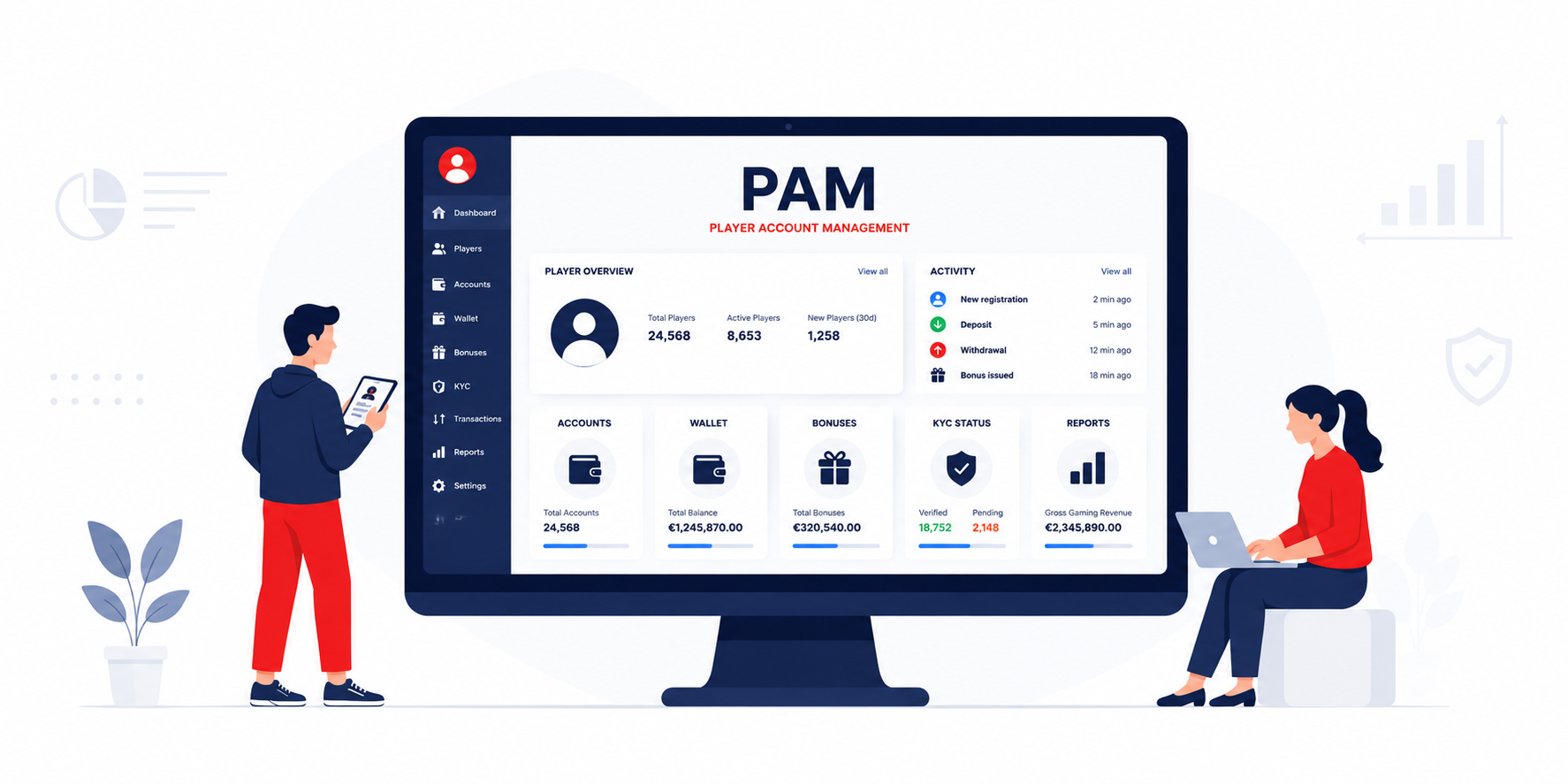
What Is PAM in iGaming?
While game aggregation connects operators with content providers, PAM systems manage player accounts, wallets, bonuses, and regulatory requirements.
What Is a Multi-Wallet System?
A multi-wallet architecture maintains separate balances for different products or purposes.
For example:
- casino wallet,
- sportsbook wallet,
- poker wallet,
- bonus wallet.
A player may therefore need to transfer funds from one balance to another before using a different gambling product.
Multi-wallet structures can also exist behind the scenes even when the player appears to see a unified balance.
The UK Gambling Commission describes the concept of a shadow wallet, where funds or tokens are transferred between integrated gambling products while remaining linked to the customer’s primary account.
Single Wallet vs Multi-Wallet: Which Is Better?
There is no universal answer.
The right architecture depends on:
- platform structure,
- number of gambling products,
- payment architecture,
- regulations,
- bonus model,
- existing integrations,
- operator strategy.
| Single Wallet | Multi-Wallet |
|---|---|
| One balance across products | Separate balances |
| Simple player experience | Greater separation between products |
| Easier cross-product use | Can support product-specific logic |
| Requires strong real-time integration | May require transfers between wallets |
| Useful for unified platforms | Useful in more fragmented environments |
From a player-experience perspective, a single wallet often feels simpler.
From a technical perspective, however, the architecture behind that experience may still involve several internal wallets or ledgers.
Real-Money Balance vs Bonus Balance
Another distinction operators need to manage is the difference between real-money funds and promotional funds.
A player’s account may contain:
- cash balance,
- bonus balance,
- free bet value,
- promotional credits,
- winnings associated with bonuses.
These balances may follow different rules.
For example, bonus funds might:
- expire,
- have wagering requirements,
- only be usable on selected games,
- have maximum stake restrictions,
- be converted into real-money balance after conditions are completed.
The wallet therefore needs to know not only how much money a player has, but also what type of balance it represents and how it may be used.
This is why wallet functionality often connects closely with the platform’s bonus engine.
Player Wallet and Payment Processing
Player wallets and payment processing are closely related but serve different purposes.
Payment processing
Handles the transfer of money through payment methods such as:
- payment cards,
- bank transfers,
- e-wallets,
- local payment systems,
- other supported payment methods.
Player wallet
Handles the player’s balance inside the iGaming platform.
The payment layer therefore communicates with the wallet when money enters or leaves the gambling ecosystem.
For example:
Deposit
Payment provider → Payment gateway → PAM → Player wallet
Withdrawal
Player wallet → PAM → Payment gateway → Payment provider
A well-integrated system should keep these processes synchronized and create clear records of each transaction.
Why Real-Time Wallet Processing Matters
Players expect balances to update immediately.
If a bet is placed, winnings are generated or a deposit is approved, the wallet should reflect the change without unnecessary delay.
Real-time wallet processing is particularly important for:
- live betting,
- casino games,
- live casino,
- quick game switching,
- multi-product platforms.
Imagine a player winning €50 in an online casino and immediately opening a sportsbook.
If both products use the same wallet architecture, the sportsbook should receive the updated balance immediately.
Delayed synchronization can lead to:
- incorrect balances,
- failed bets,
- duplicated transactions,
- confusing player experiences,
- reconciliation problems.
For this reason, transaction integrity and synchronization are fundamental parts of wallet architecture.
How Does a Player Wallet Support Responsible Gaming?
Because the wallet records player financial activity, it is also an important source of information for responsible gaming systems.
Wallet data can help platforms track:
- deposits,
- withdrawals,
- spending levels,
- losses,
- net deposits,
- transaction patterns.
This information can then interact with responsible gaming functionality such as:
- deposit limits,
- loss limits,
- spending controls,
- player monitoring,
- account restrictions.
For example, a deposit limit may require the wallet or payment system to verify how much a player has already deposited during a defined period before another transaction is accepted.
The UK Gambling Commission requires customers to be able to access their net deposit information and defines net deposits as deposits minus withdrawals over the relevant account history.
Operators should therefore consider wallet data an important part of the wider responsible gaming framework, not merely a financial ledger.
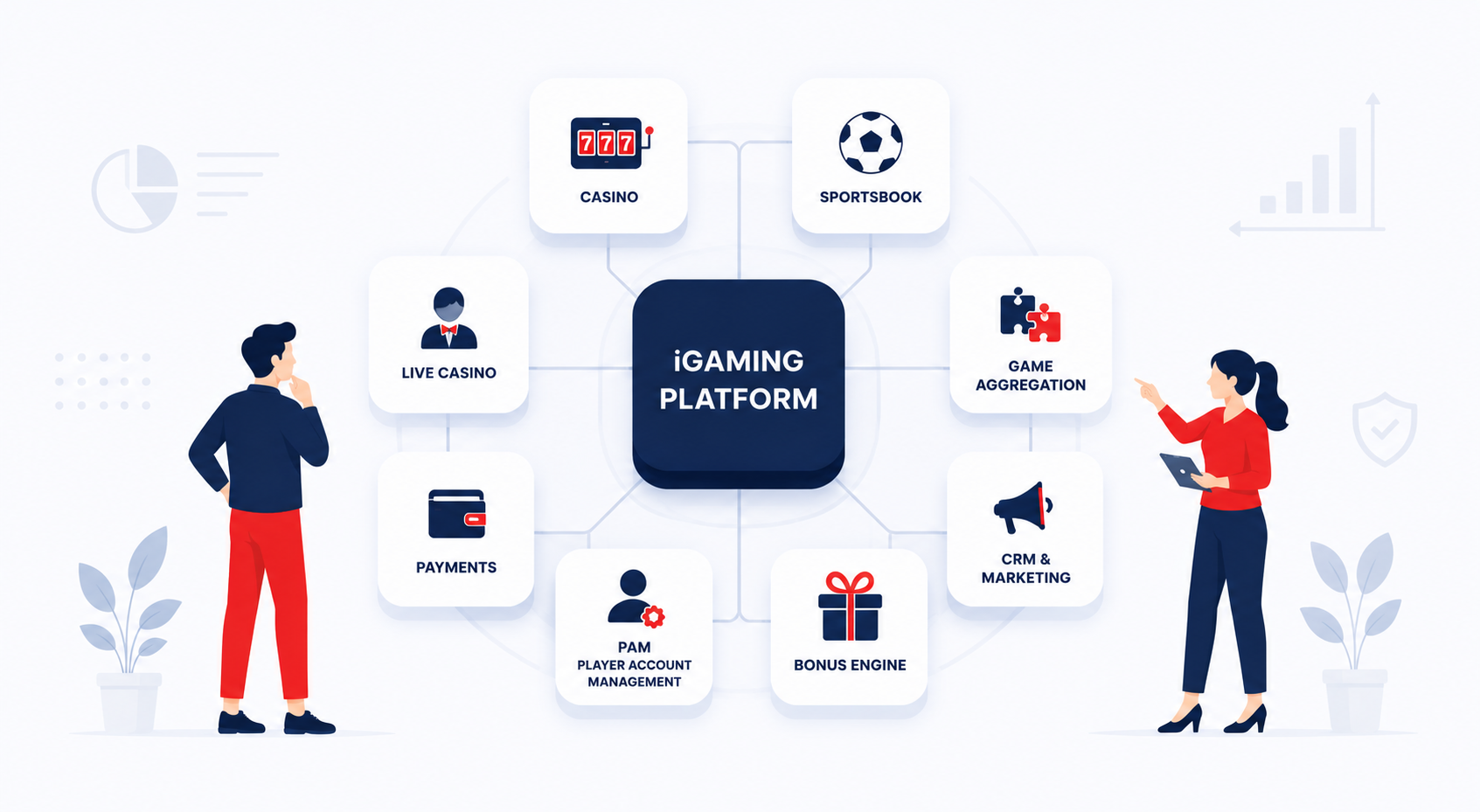
What Is an iGaming Platform? Complete Guide for Operators
An iGaming platform is the foundation of every successful online casino and sportsbook. Learn how operators manage players, games, payments, compliance, and daily operations through a single technology ecosystem.
Player Wallet, KYC and AML
Wallet activity can also support KYC and AML controls.
Operators may need to understand:
- who deposited funds,
- which payment method was used,
- how funds were wagered,
- how winnings were generated,
- where withdrawals are being sent.
Unusual wallet activity may require further review.
Examples can include:
- unusually high deposits,
- rapid deposit and withdrawal patterns,
- multiple payment methods,
- transactions inconsistent with expected player behaviour,
- withdrawals after very limited gameplay.
Regulators increasingly focus on the relationship between player identity, payment methods and transaction behaviour. The UK Gambling Commission’s 2026 risk assessment, for example, identifies third-party payments, unusual wagering patterns, multiple payment methods and certain e-wallet activity as relevant money-laundering risks for remote casino operators.
The wallet therefore provides important transaction data that can support wider AML and risk-management processes.
What Information Should Players Be Able to See?
Transparency is an important part of wallet design.
Depending on the market and regulatory requirements, players may need access to information such as:
- current balance,
- deposit history,
- withdrawal history,
- betting history,
- winnings,
- bonus activity,
- transfers between products,
- net deposits.
For example, the UK Gambling Commission defines specific customer account and balance requirements, including access to current balances and historical information about deposits, withdrawals, bets and winnings.
For operators, this means that wallet architecture should support not only transaction processing but also clear and accessible reporting.
Player Wallet and Customer Funds
It is also important to distinguish between a player wallet balance displayed by software and the actual handling of customer funds by the operator.
The wallet represents the amount available to the player inside the platform.
The underlying money may be subject to separate regulatory rules governing how customer funds are held and protected.
For example, the UK Gambling Commission requires most remote operators holding customer funds to segregate those funds from their business accounts.
This distinction is important for operators:
Wallet architecture manages balances and transactions.
Customer-fund regulation determines how the underlying money must be held and protected.
What Should Operators Look for in a Player Wallet System?
When choosing a player wallet system, operators should evaluate more than basic deposit and withdrawal functionality.
Real-Time Transaction Processing
The wallet should be able to process bets, winnings, deposits and withdrawals quickly and consistently.
Transaction Integrity
Every transaction should be recorded accurately and protected against duplication or loss.
Multi-Product Support
Operators offering several verticals should consider how the wallet supports:
- online casino,
- sportsbook,
- live casino,
- poker,
- lotteries,
- other gaming products.
Single Wallet Capability
A unified wallet can simplify movement between products and provide a consistent account balance.
Multi-Currency Support
Operators active across several markets may need balances and transactions in multiple currencies.
Bonus Integration
The wallet should communicate with bonus and promotional systems so that real-money and bonus balances are handled correctly.
Payment Integration
Deposits and withdrawals need to connect reliably with payment service providers and payment gateways.
PAM Integration
Wallet data should be available to the wider Player Account Management ecosystem.
Responsible Gaming Controls
The system should support limits, monitoring and other controls required by the operator and relevant regulation.
Transaction History and Reporting
Operators need detailed financial records for customer support, reconciliation, analytics and compliance.
Security
Financial data and transaction APIs should be protected against unauthorized access, manipulation and fraud.
Scalability
The wallet should remain reliable as transaction volumes, player numbers and product integrations grow.
Why Is the Player Wallet Important for Operators?
The player wallet sits at the intersection of several critical iGaming processes.
It connects:
Players → Payments → PAM → Games → Sportsbook → Bonuses → Compliance → Reporting
If the wallet does not work correctly, many other parts of the platform are affected.
A reliable wallet contributes to:
- accurate balances,
- smooth deposits and withdrawals,
- faster switching between products,
- consistent transaction records,
- better platform integration,
- regulatory reporting,
- responsible gaming controls.
This makes wallet architecture one of the foundational components of a modern iGaming platform.
Player Wallet as Part of an iGaming Platform
A player wallet does not operate independently.
It communicates with multiple systems throughout the platform ecosystem.
A simplified architecture may look like this:
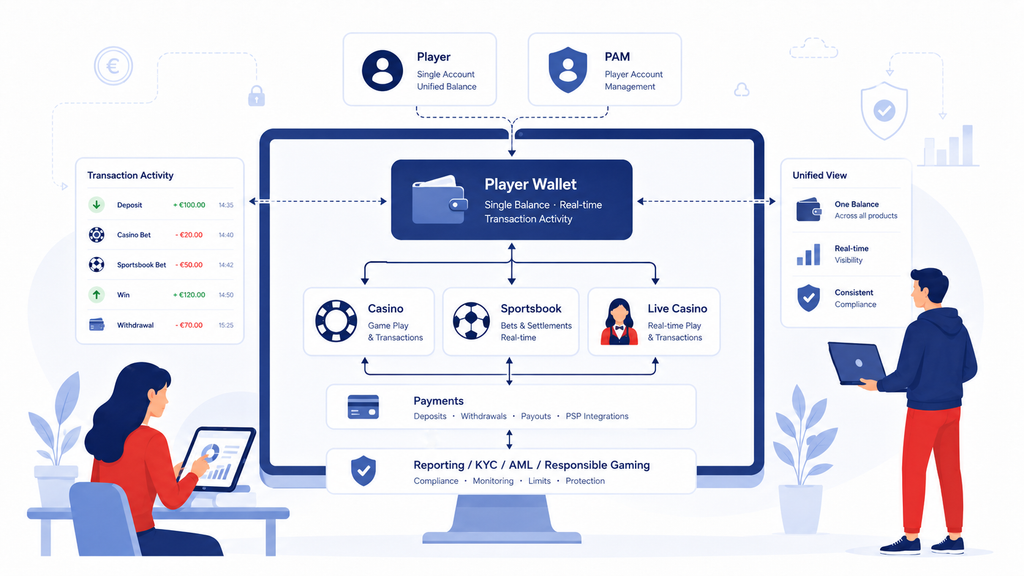
The exact architecture varies between operators, but the fundamental requirement remains the same: all systems need a consistent understanding of the player’s available funds and financial activity.
This is why the wallet is often treated as one of the core transactional components of the wider iGaming platform.
Player Wallet with SYNOT Interactive
SYNOT Interactive’s Player Account Management solution brings together player account functionality, wallet management and other operational components within the wider iGaming ecosystem.
The platform can connect player accounts with gambling products, payment infrastructure, bonus systems, responsible gaming functionality and reporting.
For operators, the objective is to create a consistent environment in which player data, financial transactions and gaming activity can be managed through connected platform components.
Explore the SYNOT Interactive Player Account Management solution to learn more about the technology behind player accounts and wallet management.
Why Work with SYNOT Interactive?
SYNOT Interactive develops and delivers modular iGaming technology for operators across regulated markets.
Our portfolio includes Player Account Management, online casino technology, game aggregation, sportsbook, lottery, poker, scratch cards, live casino solutions, and supporting integration services. This allows operators to combine the products and modules that correspond to their particular market, business model, and technological environment.
Our experience includes new platform launches as well as complex integrations into existing operator ecosystems. We understand that successful delivery depends not only on functionality but also on regulatory readiness, integration ownership, project coordination, data management, and long-term operational support.
SYNOT Interactive currently works with more than 40 customers across 13 countries. Through our casino aggregation solution, operators can access a portfolio of more than 13,000 games from over 90 gaming providers.
Explore our iGaming product portfolio or contact our team to discuss your platform requirements.
FAQ About Player Wallets in iGaming
A player wallet in iGaming is a system that maintains a player’s balance and records monetary transactions such as deposits, withdrawals, stakes and winnings.
No. The player account contains the wider player profile and account information. The wallet is the component responsible primarily for financial balances and transactions.
A single wallet allows players to use one balance across several gambling products, such as casino, sportsbook and live casino.
A casino wallet stores and manages the player’s balance within the gambling platform. A payment method transfers money between the player and the operator.
Yes. A wallet system may maintain separate balances or accounting rules for real money, bonus funds, free bets and other promotional value.