


What Is Live Casino and How Does It Work?
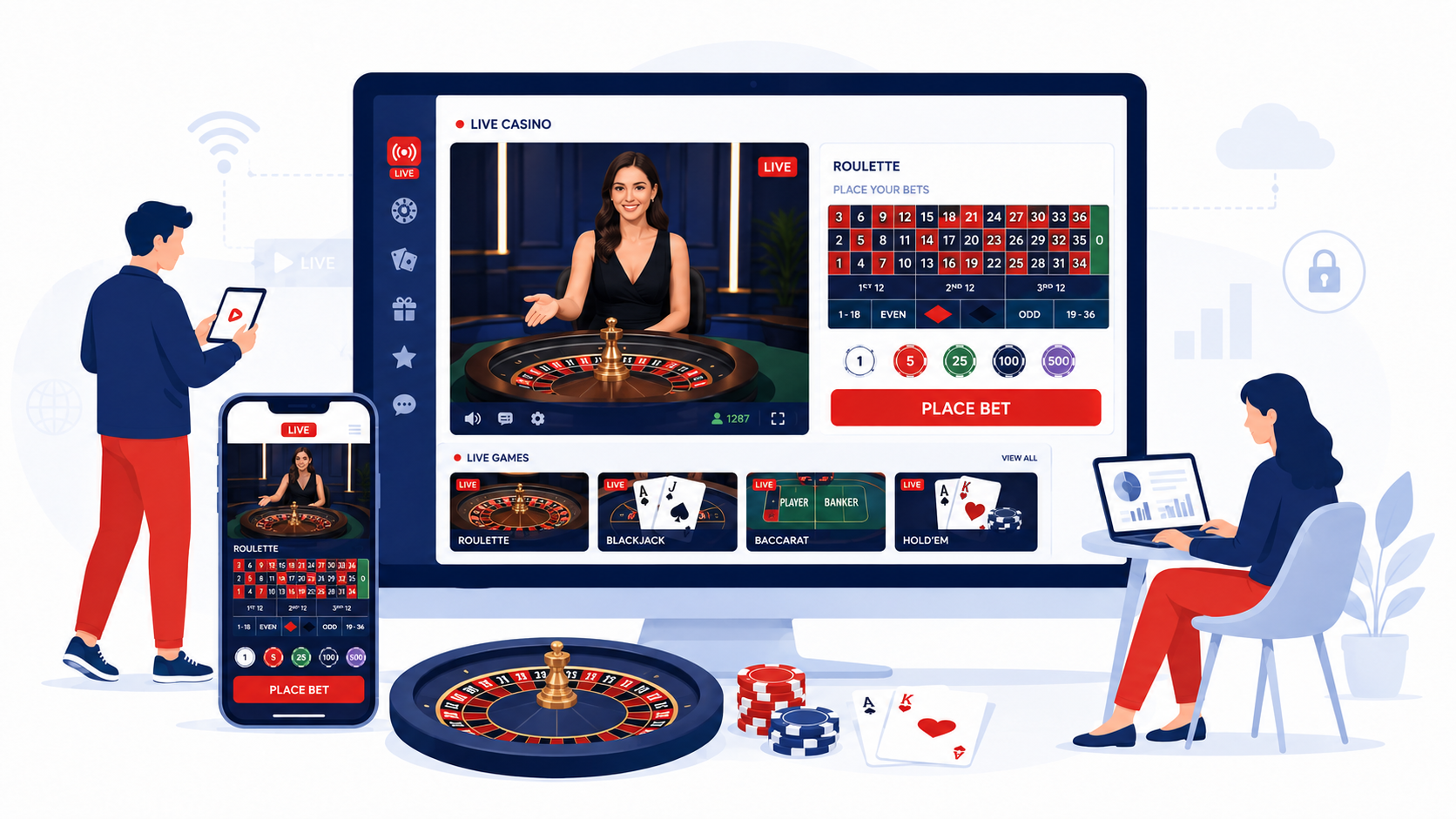
To understand what live casino is, it is important to look at both the player experience and the technology behind it.
Live casino brings the atmosphere of a traditional casino table into an online environment. Instead of playing against a fully computer-generated game, players join a real-time session hosted by a professional dealer or croupier.
Games such as roulette, blackjack, baccarat and casino hold’em are broadcast from a professional studio or another specially prepared environment. Players watch the action through a live video stream, place their bets using a digital interface and follow the result as it happens.
For operators, however, live casino is much more than a video feed. A complete live casino solution combines trained dealers, physical gaming equipment, streaming infrastructure, game software, an online lobby, player interaction, payment and account systems, localization, security and regulatory controls.
This guide explains what live casino is, how live dealer games work and what operators should consider when adding live casino to their gaming portfolio.
What Is Live Casino?
Live casino is a form of online casino gaming in which games are conducted by real dealers and streamed to players in real time.
The dealer may deal physical cards, spin a roulette wheel or manage another table game while cameras capture the action. Players participate remotely through a casino website or mobile application.
Unlike conventional online casino games, live casino does not rely solely on computer-generated visual animations to present the gameplay. The physical actions performed at the table form an essential part of the experience.
A typical live casino environment includes:
- professional dealers or croupiers,
- physical cards, wheels, tables or other gaming equipment,
- cameras and live-streaming technology,
- game control and result-tracking systems,
- a digital betting interface,
- an online live casino lobby,
- player communication tools,
- security and monitoring systems,
- integration with the operator’s casino platform.
Together, these components allow players to experience real-time table games without needing to visit a physical casino.
How Does Live Casino Work?
From the player’s perspective, joining a live dealer game is relatively simple. The player opens the live casino lobby, selects a table, chooses a betting position and places a wager before the betting period closes.
Behind this straightforward experience is a combination of physical gaming operations and digital technology.
The player selects a live casino table
The live casino lobby displays available games and tables. These may be organized according to game type, language, table limits, dealer, market or other operator-defined categories.
Players can either enter the general lobby or, depending on the implementation, open a particular live table directly.
A well-designed lobby helps players understand:
- which games are currently available,
- the minimum and maximum bets,
- the language used at the table,
- the number of available seats,
- the current game status,
- whether the table is shared or dedicated.
The structure, categories, naming and visual appearance of the lobby can often be adapted to the operator’s requirements.
A real dealer conducts the game
A trained dealer manages the physical game according to its rules and the applicable operating procedures.
In roulette, the dealer accepts the end of the betting period and spins the physical wheel. In blackjack, the dealer distributes cards and manages player decisions. In baccarat, the dealer handles the cards while the game system records the outcome.
The dealer also communicates with players, announces game stages and helps maintain the pace and atmosphere of the session.
This human element is one of the most important distinctions between live casino and standard RNG-based casino games.
The table is broadcast through a live video stream
Cameras capture the dealer, table and gaming equipment from one or more angles. The video is then delivered to players through the online casino interface.
The stream needs to be stable and synchronized closely with the betting system. Excessive delay could make it difficult for players to follow the action or place bets within the available time.
Live casino technology therefore focuses heavily on:
- video quality,
- stream stability,
- low latency,
- synchronization,
- support across different devices and connections.
A player may also be able to switch between camera views or see close-up footage of cards, wheels or game results.
The player places bets through a digital interface
Although the game takes place at a physical table, players place their bets digitally.
The game interface typically displays:
- available betting positions,
- stake values,
- remaining betting time,
- previous results,
- current balance,
- possible side bets,
- game information and rules.
When the betting period closes, the interface stops accepting wagers. The dealer then completes the round and the system determines the result.
The result is recorded and settled
Live casino systems use supporting technology to record what happens at the table.
Depending on the game, physical actions may be detected using card-reading equipment, sensors, optical recognition or other game control technology. This data is transferred to the digital interface so that the game result can be displayed and the appropriate wagers can be settled.
The player’s casino balance is then updated through the connected platform or wallet system.
Players can interact with the table
Live casino is designed as an interactive experience.
Players may communicate with the dealer through text chat and follow announcements during the game. Depending on the product and table setup, the dealer may respond to individual messages or address the players as a group.
This real-time communication helps differentiate live dealer games from purely automated online casino products.
What Is PAM in iGaming?
While game aggregation connects operators with content providers, PAM systems manage player accounts, wallets, bonuses, and regulatory requirements.
What Is a Live Casino Dealer?
A live casino dealer is a trained professional who conducts a casino game for online players through a live stream.
The role involves more than dealing cards or spinning a roulette wheel. Dealers must understand the game rules, follow established operating procedures, communicate clearly and maintain a consistent pace.
A professional live casino dealer is generally expected to:
- conduct the game accurately,
- explain or announce key game stages,
- communicate with online players,
- follow security procedures,
- work with the supporting game technology,
- maintain a professional and welcoming presentation,
- adapt communication to the relevant language and market.
Dealer quality can significantly influence how players perceive a live casino brand. For that reason, recruitment, training and ongoing performance management are important parts of operating a live dealer product.
What Are the Most Common Live Casino Games?
The live casino portfolio usually focuses on familiar table games that can be effectively delivered through real-time streaming.
Live Roulette
Live roulette uses a physical wheel and ball operated by a real dealer. Players place bets through the digital interface before betting closes and then watch the wheel determine the result.
Different table configurations, betting limits and localized versions may be offered.
Live Blackjack
In live blackjack, the dealer distributes physical cards while players decide whether to hit, stand or use other available actions.
The interface communicates each player’s decision to the table system. Different variants may include alternative rules, table capacities or side bets.
Live Baccarat
Live baccarat is well suited to real-time streaming because player decisions are relatively limited and the game can maintain a consistent pace.
Players generally wager on the Player hand, Banker hand or a Tie before the dealer reveals the cards.
Live Casino Hold’em
Live casino hold’em combines physical card dealing with digital betting. Unlike traditional peer-to-peer online poker, players compete against the house rather than against one another.
Other Live Dealer Games
provider may also offer:
- different blackjack variants,
- alternative poker-based table games,
- game-show-inspired products,
- localized table games,
- VIP or higher-limit tables.
The appropriate portfolio depends on the operator’s target market, player preferences, licence conditions and overall casino strategy.
What Is an iGaming Platform? Complete Guide for Operators
An iGaming platform is the foundation of every successful online casino and sportsbook. Learn how operators manage players, games, payments, compliance, and daily operations through a single technology ecosystem.
Live Casino vs RNG Casino Games
The main difference between live casino and RNG casino games is how the gameplay and result are produced.
RNG stands for random number generator. In a conventional digital casino game, software generates the outcome and presents it through animations. The entire experience takes place within the game application.
In live casino, the outcome is connected to real actions at a physical table. A dealer handles real equipment while the game is broadcast to players.
| Live casino | RNG casino games |
|---|---|
| Hosted by a real dealer | Controlled by game software |
| Streamed in real time | Presented through digital animation |
| Based on physical table action | Outcome generated digitally |
| Usually played at a fixed game pace | Players often control the pace |
| Supports real-time interaction | Usually designed for individual play |
| Requires streaming infrastructure | Generally requires less bandwidth |
Neither format replaces the other. They serve different player preferences and can complement each other within a broader online casino portfolio.
RNG games can provide fast, flexible and highly varied gameplay. Live casino adds human interaction, real-time entertainment and a stronger connection to the traditional casino environment.
Dedicated vs Shared Live Casino Tables
Operators can typically choose between shared tables and dedicated tables.
Shared live casino tables
A shared table is made available to players from multiple operator brands.
The underlying game, studio and dealer are managed centrally by the live casino provider. Operators can add the content to their portfolio without establishing a fully separate table environment.
Shared tables can be suitable for operators that want:
- a faster route to launch,
- access to established live games,
- lower operational complexity,
- a broad portfolio without managing their own studio,
- flexibility while testing player demand.
Branding and customization possibilities may be more limited because several operators share the same environment.
Dedicated live casino tables
A dedicated table is reserved for a particular operator or brand.
The environment may include customized table design, colours, logos, dealer presentation, language and other brand-specific elements. Depending on the project, an operator may launch one dedicated table or create a wider branded live casino environment.
Dedicated tables may be appropriate for operators seeking:
- stronger brand visibility,
- a differentiated player experience,
- market-specific presentation,
- greater control over the environment,
- tables designed for particular player segments.
Dedicated setups generally require more preparation, branding work and operational planning than shared tables.
The right model depends on the operator’s budget, audience, market position and desired level of customization.
What Is Game Aggregation in iGaming? Complete Guide for Operators
Accessing hundreds of casino games no longer requires dozens of separate integrations. Discover how game aggregation works and why it has become a key advantage for operators looking to scale quickly and efficiently.

What Technology Is Needed for Live Casino?
A complete live casino product relies on several connected technology layers.
Studio and gaming equipment
The physical environment includes gaming tables, cards, roulette wheels, lighting, cameras and supporting studio equipment.
The setup must enable both reliable gameplay and a consistent visual presentation.
Video-streaming infrastructure
The stream must deliver the table action across different devices and network conditions.
Important factors include:
- stream quality,
- connection stability,
- latency,
- synchronization,
- device compatibility,
- scalability during periods of higher demand.
Game control system
The game control system connects physical events at the table with the online interface.
It records the game status, manages betting stages, distributes relevant data and helps ensure that the digital information corresponds with the physical game.
Player interface
The front end enables players to place bets, view their balance, follow previous results, communicate with the dealer and access game information.
It should remain clear and usable across desktop, tablet and mobile screens.
Live casino lobby
The lobby organizes games, tables and categories. It may also support direct launches into specific games or a broader browsing experience where players move between available tables.
Platform and wallet integration
Live casino must communicate with the wider online casino ecosystem.
The integration may include:
- player authentication,
- account balances,
- wagers and payouts,
- session management,
- game history,
- responsible gaming controls,
- reporting,
- fraud and security monitoring.
Operators therefore need to assess not only the visible game experience but also how the live casino product connects with their existing platform.

Why Is Low Latency Important?
Latency is the delay between an event occurring at the live table and the player receiving the corresponding video or game data.
Some delay is unavoidable in any online stream, but live casino requires close synchronization between:
- the dealer’s actions,
- the video stream,
- the betting countdown,
- player decisions,
- game results,
- balance updates.
When latency becomes too high, the experience can feel disconnected. A player may see the dealer close betting while the digital interface appears to remain open, or the video may lag behind the displayed game status.
Low-latency delivery therefore contributes to a smoother and more credible live casino experience.
Why Are Localization and Branding Important?
Live casino is closely connected to human communication. Language, presentation and familiarity can therefore influence the overall experience more directly than in many automated games.
Localization may include:
- dealers speaking the local language,
- translated game interfaces,
- local currency display,
- market-specific betting limits,
- localized table names,
- regional game preferences,
- visual branding,
- regulatory messages and player information.
For an operator entering a particular regulated market, localization is not only a design consideration. The product may also need to reflect local legal, technical and responsible gaming requirements.
Dedicated tables provide the greatest opportunity for brand-specific presentation, while shared tables can provide a more standardized route to market.
What Should Operators Consider When Choosing a Live Casino Provider?
Selecting a live casino provider requires more than reviewing the visual quality of a demonstration table.
Operators should evaluate the complete delivery model.
Game portfolio
The provider should offer games and variants relevant to the target audience. A large portfolio is useful only when it contains appropriate content for the operator’s market.
Shared and dedicated options
Operators should understand which table models are available and how much customization each model supports.
Dealer quality and languages
Dealer recruitment, training, professionalism and language coverage all contribute to the quality of the final experience.
Technical integration
The operator should clarify how games, lobby functions, wallet transactions, reporting and player sessions connect with the existing platform.
Streaming performance
Video quality matters, but stability, latency and device performance are equally important.
Localization
The solution should support the languages, currencies, limits and interface adaptations required for the relevant markets.
Compliance and security
The provider and operator must be able to meet the technical, regulatory and certification requirements applicable to the launch market.
Live dealer operations must comply with the technical and regulatory requirements of each target market. For example, the UK Gambling Commission’s standards for live dealer studios cover fairness, independent auditing, dealer training, supervision, equipment security and the retention of game records.
Branding possibilities
For dedicated environments, operators should establish which visual and operational elements can be customized.
Operational support
Live casino is an ongoing service. Operators should therefore assess monitoring, incident response, dealer operations, technical support and future product development.
A suitable provider should align the visible player experience with the operator’s technical, commercial and regulatory requirements.
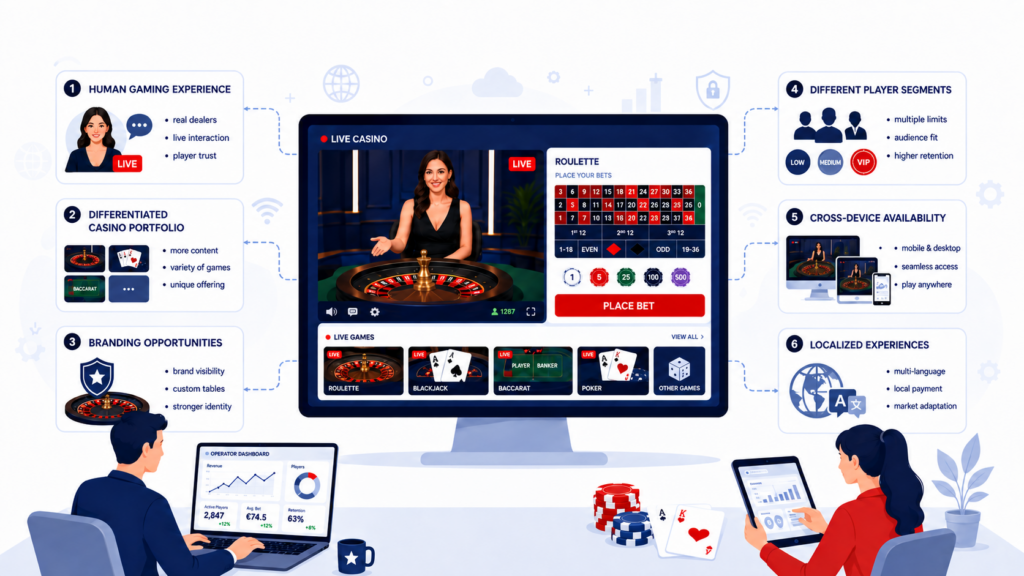
What Are the Benefits of Live Casino for Operators?
Live casino can broaden an operator’s offering by adding a format that differs meaningfully from slots and conventional digital table games.
Potential benefits include:
A more human gaming experience
Real dealers and live communication introduce a human element into an otherwise digital environment.
A differentiated casino portfolio
Live dealer games provide operators with another major content category alongside slots, RNG table games, instant games and other verticals.
Branding opportunities
Dedicated tables can present the operator’s colours, identity and market positioning directly within the game environment.
Support for different player segments
Operators can offer tables with different languages, limits, games and presentation styles.
Cross-device availability
Modern live casino products can be made available through desktop and mobile environments, provided that the interface and stream are properly optimized.
Localized experiences
Language support and adaptable table environments can help operators create a product suited to a particular market.
The actual value will depend on the quality of the integration, portfolio, operations and overall player journey.
How Can an Operator Launch Live Casino?
Launching live casino normally involves several stages.
- Define the target market and player audience.
- Select the relevant games and table model.
- Choose between shared and dedicated environments.
- Confirm regulatory and certification requirements.
- Plan the technical and wallet integration.
- Configure the live casino lobby and game categories.
- Prepare localization and branding.
- Test gameplay, streaming and transaction flows.
- Launch the product and monitor its performance.
A shared-table implementation may offer a more direct route to launch. A fully dedicated environment usually requires additional branding, operational and technical preparation.
The process should therefore be designed around the operator’s existing infrastructure, licence conditions, commercial objectives and market strategy.
Live Casino with SYNOT Interactive
SYNOT Interactive provides live casino solutions designed to combine real-time gameplay with a flexible online gaming environment.
The solution supports professional live dealers, high-quality streaming, cross-device availability, localized language and interface options, and both shared and dedicated table models.
Operators can incorporate established live dealer games such as roulette, blackjack, baccarat and casino hold’em into their wider online casino offering.
The final setup can be adapted according to the operator’s brand, target market and technical requirements.
Explore the SYNOT Interactive Live Casino solution or contact our team to discuss a suitable setup for your online casino.
Final Thoughts
Live casino connects the familiarity of a physical casino table with the accessibility of an online platform.
A complete solution requires much more than a dealer and a camera. Streaming, game control, betting interfaces, platform integration, localization, compliance, security and professional operations must all work together in real time.
Operators considering live casino should decide which table model suits their strategy, how the product will connect with their existing platform and what level of localization and branding their market requires.
With the right technology and delivery model, live casino can become a distinct and valuable part of a broader online casino portfolio.
FAQ about Live Casino
Live casino is a form of online casino gaming in which real dealers conduct games from a studio or casino environment while the gameplay is streamed to players in real time.
Players watch a real dealer through a live video stream and place bets using a digital interface. The physical events at the table are recorded by the game system, which processes the results and settles the wagers through the connected casino platform.
The terms are commonly used interchangeably. Live casino refers to the overall category, while live dealer casino emphasizes that the games are hosted by real dealers.
Common live casino games include roulette, blackjack, baccarat and casino hold’em. Providers may also offer localized variants, side bets, game-show formats and dedicated branded tables.
Yes. Modern live casino software can support desktop, tablet and mobile devices, provided that the video stream and betting interface are optimized for different screen sizes and connection conditions.