


What Is Online Poker and How Does It Work? Complete Guide for Operators

Online poker is a digital version of traditional poker that allows players to compete against each other through an online gaming platform.
Unlike most online casino games, where players typically play against the house or a predefined game mechanism, online poker is primarily player-versus-player. The operator provides the technology, game environment, tournament structures, player accounts and operational tools required to manage the poker ecosystem.
For operators, online poker therefore involves much more than displaying cards on a screen. It operates within the broader iGaming ecosystem, connecting player accounts, payments, compliance tools and gaming technology. A complete online poker platform combines a poker engine, player-facing game client, tournament management, back-office tools, player account management, wallet integration, reporting and player behaviour monitoring.
This guide explains what online poker is, how it works, which technologies power it and what operators should consider when adding poker to their iGaming portfolio.
What Is Online Poker?
Online poker is a form of digital gambling in which players participate in poker games through a website, mobile device or online gaming platform.
The basic rules are based on traditional poker formats. Players receive cards, place bets and compete for a pot according to the rules of the selected game.
The key difference is that the entire gaming environment is managed digitally.
An online poker platform must handle:
- player seating,
- card distribution,
- betting rounds,
- blinds and stakes,
- game results,
- tournament structures,
- player balances,
- game history,
- reporting,
- and player behaviour data.
For operators, online poker is therefore both a gaming product and a complex technology environment.
How Does Online Poker Work?
At the most basic level, an online poker session follows a simple process:

Player login → Poker lobby → Table or tournament selection → Game participation → Betting rounds → Game result → Updated player balance
Behind this process, several systems communicate with each other.
When a player enters a poker game, the platform must confirm the player account, check available balance, place the player at the selected table and communicate with the poker engine.
The poker engine then manages the game logic, including:
- card distribution,
- betting actions,
- blinds,
- pots,
- player turns,
- game results,
- and settlement.
After each game or tournament action, the relevant information is sent back to the player account and wallet systems.
This communication needs to happen accurately and in real time.
What Is a Poker Engine?
A poker engine is the core technology responsible for managing poker game logic and player interaction.
It determines how each poker hand progresses and ensures that game rules are applied consistently.
The poker engine typically manages:
- table logic,
- player positions,
- card distribution,
- betting rounds,
- blinds,
- pots,
- player actions,
- tournament progression,
- and final game settlement.
The poker engine operates in the background, while players interact with the game through the frontend poker client.
For operators, the reliability and scalability of the poker engine are essential because multiple games and tournaments may be running simultaneously.
What Is an Online Poker Platform?
An online poker platform is the complete technology environment required to operate poker online.
The poker engine is only one part of this environment.
A complete online poker platform may include:
- poker engine,
- frontend client,
- poker lobby,
- tournament management,
- back office,
- Player Account Management,
- wallet integration,
- player behaviour tools,
- reporting,
- and operational controls.
The platform connects the player-facing poker environment with the operator’s wider iGaming platform and technology infrastructure.
This allows poker to operate alongside other gaming verticals such as casino, sportsbook and live casino while sharing player accounts and financial infrastructure.
What Is a Poker Frontend Client?
The poker frontend client is the interface players use to interact with the poker product.
It typically includes:
- poker tables,
- cards and chips,
- betting controls,
- tournament information,
- player information,
- game history,
- and navigation between games.
Modern poker clients are often browser-based, allowing players to access poker without installing additional software.
Depending on the implementation, the client may also support desktop, tablet and mobile devices as well as portrait and landscape layouts.
For operators, the frontend client also provides opportunities for branding and customisation.
What Is a Poker Lobby?
The poker lobby is the main navigation area where players choose which games or tournaments they want to join.
A typical poker lobby allows players to browse available:
- cash games,
- Sit & Go tournaments,
- multi-table tournaments,
- tournament series,
- qualifications,
- and scheduled events.
Players may also be able to filter games according to stakes, game type, number of players or tournament format.
For operators, the poker lobby plays an important role in player navigation and product discovery.
Cash Games vs Poker Tournaments
Online poker generally includes several game and tournament formats. The main differences relate to how players join, how long the game lasts and how winnings are distributed.
| Format | How It Works | Best Suited For |
|---|---|---|
| Cash Games | Players join tables with real-value chips and can usually leave according to the table rules. | Flexible sessions and ongoing player activity |
| Sit & Go | The tournament starts automatically once the required number of players has registered. | Shorter tournament sessions |
| Multi-Table Tournaments | Large numbers of players compete across several tables until the tournament reaches its final stages. | Scheduled events, tournament series and larger prize pools |
Operators can combine these formats to create a poker offering that supports both continuous cash-game activity and scheduled tournament engagement.
What Is Sit & Go Poker?
Sit & Go is a tournament format that begins when the required number of players has registered.
Unlike scheduled tournaments, Sit & Go events do not necessarily begin at a predefined time.
Once enough players join, the tournament starts automatically.
This makes Sit & Go a flexible format that sits between traditional cash games and large scheduled tournaments.
What Are Multi-Table Tournaments?
Multi-table tournaments, often referred to as MTTs, allow larger numbers of players to compete across multiple poker tables.
As players are eliminated, the remaining players are progressively consolidated into fewer tables.
The tournament continues until the final players compete for the remaining prize positions.
For operators, multi-table tournaments require advanced tournament management because the system must coordinate:
- player registration,
- table balancing,
- blind structures,
- player elimination,
- prize structures,
- and final settlement.
How Does Online Poker Tournament Management Work?
Tournament management gives operators the tools needed to configure and operate different poker tournament formats.
Depending on the poker platform, operators may be able to manage:
- tournament series,
- satellites,
- qualifications,
- guaranteed prize pools,
- late registration,
- re-entry,
- rebuy formats,
- vouchers,
- and tournament structures.
Tournament management is particularly important for operators that want to build recurring poker events or larger tournament campaigns.
It also allows operators to create qualification paths where players can enter larger events through smaller tournaments.
How Does Online Poker Connect With PAM and Player Wallets?
Online poker does not operate independently from the wider iGaming environment.
It normally communicates with the operator’s Player Account Management system, which manages the identity and status of each player.
The connection can be simplified as:
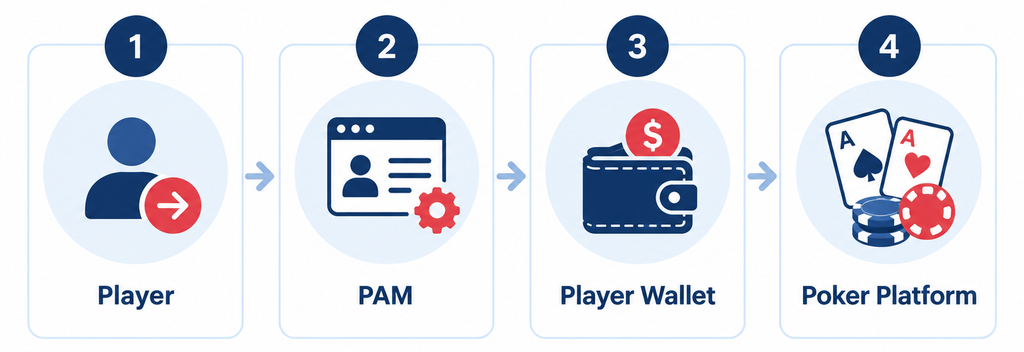
Player → PAM → Player Wallet → Poker Platform
The PAM system manages the player account, while the player wallet records deposits, withdrawals, winnings and other financial transactions across the gaming environment.
When a player enters a cash game or tournament, funds may be reserved, transferred or settled according to the game outcome.
The poker platform then communicates the relevant transaction information back to the wallet and PAM environment.
This allows poker to operate within the same player ecosystem as casino, sportsbook and other gaming products.
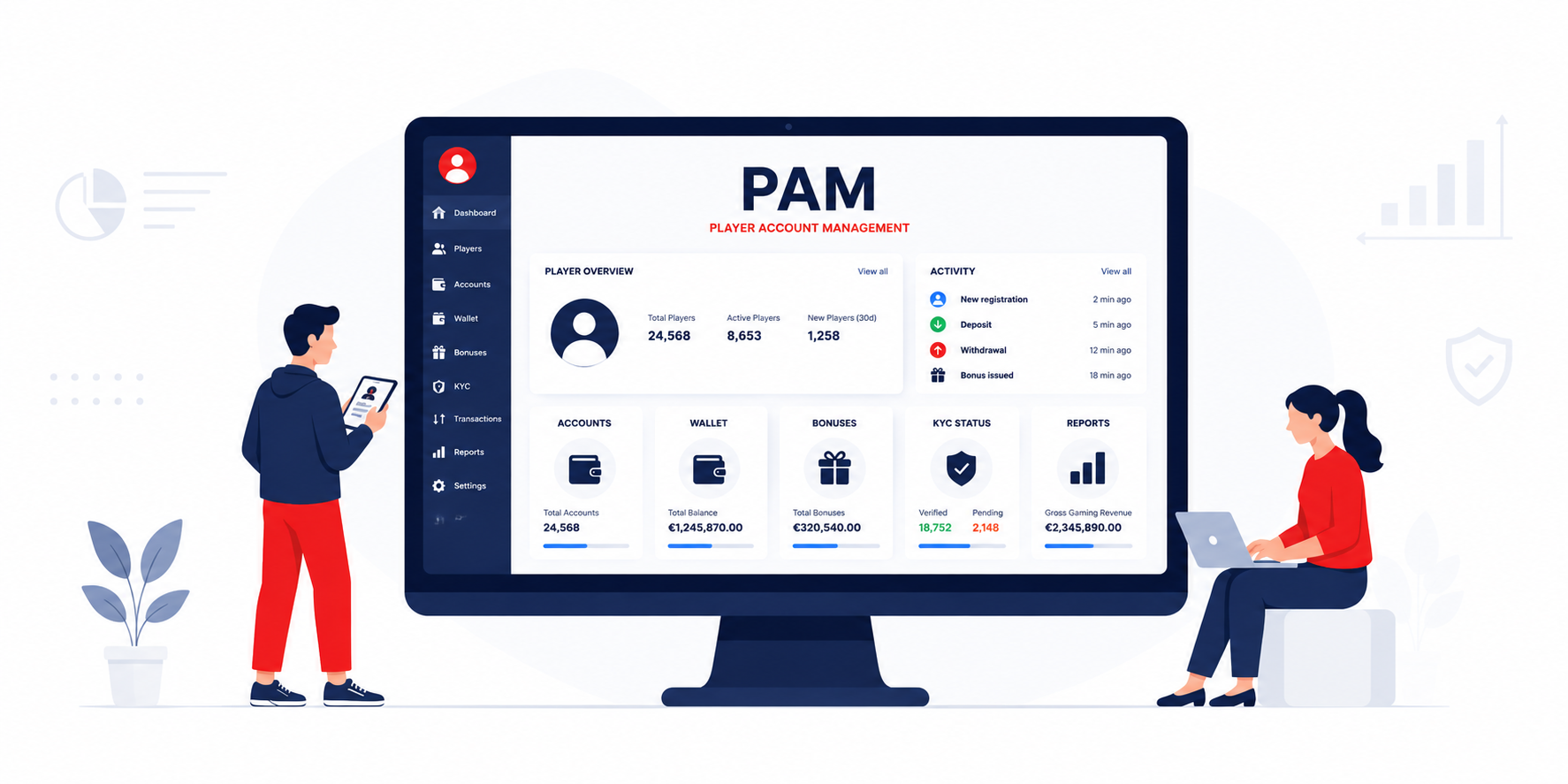
What Is PAM in iGaming?
While game aggregation connects operators with content providers, PAM systems manage player accounts, wallets, bonuses, and regulatory requirements.
How Are Player Funds Managed in Online Poker?
Player funds must be recorded accurately throughout the entire poker session.
Depending on the poker format, transactions may include:
- tournament buy-ins,
- cash game buy-ins,
- winnings,
- tournament payouts,
- re-entry payments,
- and other poker-related transactions.
The player wallet records these movements and updates the available balance.
Accurate settlement is particularly important in poker because funds move continuously between individual player accounts and poker games.
How Do Online Poker Platforms Support Player Behaviour Analysis?
Because online poker involves players competing directly against each other, operators need tools that help them analyse unusual behaviour.
Player behaviour analysis may include indicators such as:
- unusual betting patterns,
- repeated activity between the same players,
- potential multiple-account activity,
- and statistical behaviour across poker sessions.
One commonly used metric is VPIP, or Voluntarily Put Money in Pot.
VPIP measures how frequently a player voluntarily contributes chips to the pot before the flop and can help operators analyse playing patterns.
Behavioural data can support investigations into potentially coordinated activity between players.
Importantly, player behaviour tools generally support operational analysis rather than replacing manual investigation and operator decision-making.
What Is Collusion in Online Poker?
Collusion occurs when two or more players cooperate in a way that gives them an unfair advantage over other participants.
For example, players could theoretically share information about their cards or coordinate betting behaviour.
Because poker is a player-versus-player game, detecting unusual relationships between accounts is an important operational consideration.
Poker platforms can provide behavioural data and analytical tools that help operators identify patterns that may require further investigation.
How Do Online Poker Platforms Address Multiple Accounts and Bots?
Operators may also need to investigate activity associated with multiple accounts or automated software.
Multiple account analysis can help identify situations where potentially related accounts display unusual behaviour.
Poker systems may also use protective mechanisms designed to make automated bot activity more difficult.
The exact security approach depends on the poker technology, operator requirements and regulatory environment.
Responsible Gaming in Online Poker
Responsible gaming in iGaming also applies to online poker, where players may participate in extended cash-game sessions or long-running tournaments.
Players may spend extended periods participating in cash games or tournaments, making tools that support controlled gambling activity important.
Responsible gaming measures can include:
- deposit limits,
- loss limits,
- session controls,
- self-exclusion,
- cooling-off periods,
- and player monitoring.
These tools are usually connected to the wider Player Account Management and responsible gaming environment rather than operating only within the poker client.
KYC and Online Poker
KYC in iGaming plays the same important role in online poker as in other regulated gaming products.
Operators may need to verify player identity, age and other required information before allowing access to gambling services or certain financial transactions.
KYC processes usually operate through the wider player account environment.
This means the poker platform can rely on verified player information without requiring a completely separate identity system.
What Should Operators Look for in an Online Poker Solution?
Choosing an online poker solution involves more than comparing available game formats. Operators need to evaluate the complete technology environment behind the product, including integration, scalability, operational tools and player management.
The following areas are particularly important when assessing an online poker platform:
| Area | What Operators Should Consider |
|---|---|
| Poker Engine | Reliable game logic, stable performance and support for required poker formats |
| Tournament Management | Tournament series, satellites, qualifications, guarantees, late registration and re-entry |
| Integration | Connection with PAM, player wallet and the wider iGaming ecosystem |
| Scalability | Ability to support increasing numbers of players, tables and tournaments |
| Player Behaviour Tools | Data and analytical tools supporting investigation of unusual player activity |
| Back Office & Reporting | Operational control over games, tournaments, transactions and reporting |
| Customisation | Branding and configuration options that match the operator’s product strategy |
These requirements should also be considered within the operator’s wider technology strategy. Our guide on how to choose an iGaming platform provider explains the broader technical, operational and commercial factors operators should evaluate when selecting an iGaming technology partner.
Online Poker as Part of an iGaming Platform
Poker can operate as a dedicated gaming product, but from an operator perspective it usually becomes part of a larger iGaming ecosystem.
A simplified architecture may look like this:
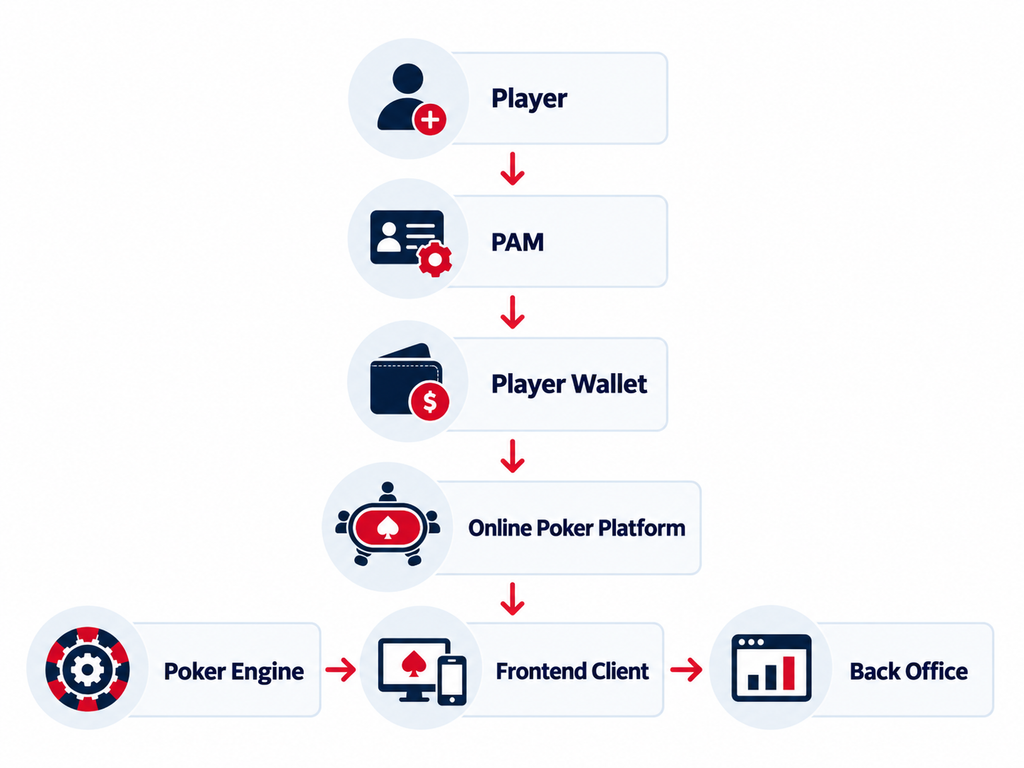
This structure allows player identity, balances and account controls to remain connected with the wider platform while the poker technology handles poker-specific gameplay and operations.
Online Poker with SYNOT Interactive
SYNOT Interactive provides a complete Online Poker Solution built around proprietary poker technology.
The solution combines:
- a proprietary poker engine,
- browser-based frontend client,
- poker back office,
- tournament management,
- player behaviour analysis tools,
- reporting,
- and flexible integration with PAM and wallet infrastructure.
Operators can deploy the solution as part of the wider SYNOT Interactive Platform or integrate it with an existing third-party PAM and wallet environment.
The solution supports cash games, Sit & Go tournaments and multi-table tournaments together with advanced tournament management features such as tournament series, satellites, qualifications, guarantees, vouchers, late registration and re-entry.
If you are considering launching or expanding an online poker product, explore our Online Poker Solution or get in touch with our team.
Online Poker in Production
A useful way to evaluate online poker technology is to look at real-world implementations.
SYNOT Interactive has already deployed online poker as part of an operator environment for Niké.sk.
The implementation demonstrates how poker can be added to an existing gaming portfolio while integrating the poker technology with the surrounding platform infrastructure.
See how we launched Online Poker for Niké.sk
Tady bych určitě odkázal na case study, protože je to přesně ten BOFU důkaz, který většina čistě informačních článků nemá.
Why Is Online Poker Important for Operators?
Online poker can broaden an operator’s product portfolio and provide a different type of player experience compared with traditional casino games.
Poker is based primarily on player-versus-player competition, creating a social and competitive gaming environment.
For operators, this may support:
- broader product diversification,
- tournament-driven engagement,
- recurring poker communities,
- cross-product player activity,
- and differentiation from casino-only competitors.
The commercial value ultimately depends on liquidity, player acquisition, tournament strategy and the wider operator ecosystem.
Final Thoughts
Online poker is much more than a digital version of a traditional card game.
Behind every poker table is a technology environment that connects players, game logic, tournaments, wallets, player accounts, reporting and operational controls.
For operators, the most important consideration is how these components work together.
A reliable poker engine provides the foundation, while tournament management, integrations, player behaviour tools and back-office functionality allow the poker product to operate effectively within the wider iGaming ecosystem.
Operators considering adding poker to their portfolio should therefore evaluate not only the player-facing game experience, but also the technology and operational infrastructure behind it.
If you are considering launching or expanding an online poker product, explore our Online Poker Solution or get in touch with our team.
Why Work with SYNOT Interactive?
SYNOT Interactive develops and delivers modular iGaming technology for operators across regulated markets.
Our portfolio includes Player Account Management, online casino technology, game aggregation, sportsbook, lottery, poker, scratch cards, live casino solutions, and supporting integration services. This allows operators to combine the products and modules that correspond to their particular market, business model, and technological environment.
Our experience includes new platform launches as well as complex integrations into existing operator ecosystems. We understand that successful delivery depends not only on functionality but also on regulatory readiness, integration ownership, project coordination, data management, and long-term operational support.
SYNOT Interactive currently works with more than 40 customers across 13 countries. Through our casino aggregation solution, operators can access a portfolio of more than 13,000 games from over 90 gaming providers.
Explore our iGaming product portfolio or contact our team to discuss your platform requirements.
Planning Your Next Online Poker Project?
Discover how our Online Poker Solution combines proprietary poker technology, advanced tournament management, flexible integration and proven production experience.
FAQ About Online Poker
Online poker is a digital form of poker that allows players to compete against each other through an online platform. The platform manages game logic, player accounts, tables, tournaments and financial transactions.
Players log into their account, select a cash game or tournament and participate through a digital poker client. The poker engine manages cards, betting rounds, game rules and results while the wider platform manages player accounts and balances.
An online poker platform is the technology environment used to operate poker online. It can include a poker engine, frontend client, lobby, tournament management, back office, reporting and integration with PAM and wallet systems.
In cash games, chips represent monetary value and players can generally join or leave according to the table rules. In tournaments, players compete using tournament chips according to a predefined tournament structure.
A multi-table tournament allows a larger group of players to compete across multiple tables. As players are eliminated, the remaining participants are consolidated until the tournament reaches its final table.