


How Do Online Scratch Cards Work? A Guide for Casino Operators

Online scratch cards are digital instant-win games that recreate the familiar experience of scratching a physical lottery ticket. Instead of removing a coating from a paper card, players use a mouse, touchscreen or another digital control to reveal symbols, numbers or prize combinations through an online casino, lottery website or mobile application.
The scratch interaction is simple from the player’s perspective. Behind it, however, the game requires a combination of game logic, outcome determination, prize configuration, wallet communication, visual design, reporting and operator controls.
For casino and lottery operators, online scratch cards can introduce a recognizable instant-win format into a wider gaming portfolio without requiring players to learn complicated rules or navigate long game rounds.
This guide explains what online scratch cards are, how they work, how digital outcomes can be determined and how they connect with a broader iGaming platform.
What Are Online Scratch Cards?
Online scratch cards are digital games inspired by traditional paper scratch tickets.
A physical scratch card conceals symbols or numbers beneath an opaque surface. The player removes the surface to reveal whether the ticket contains a winning combination.
A digital scratch card follows a similar visual principle. The concealed playing area appears on a screen, and the player reveals its contents using a touchscreen gesture, mouse movement or another interactive control. The result is then displayed and any applicable winnings are credited through the connected gaming system.
Depending on the game design, players may need to:
- match identical symbols,
- reveal a particular number,
- uncover winning combinations,
- find special symbols,
- complete a pattern,
- reveal a multiplier,
- activate a bonus mechanic,
- select from several concealed positions.
Although the scratch action is an important part of the presentation, the game itself is managed digitally. The visual layer, game rules, prize model and result-processing systems must work together to deliver the complete experience.
Online scratch cards can be offered as standalone games or as part of the broader iGaming ecosystem, alongside online casino, sportsbook, poker, lottery and other instant-win products.
How Do Online Scratch Cards Work?
From the player’s point of view, the process is usually straightforward:

Game selection → Stake or ticket purchase → Result generation or allocation → Scratch interaction → Prize evaluation → Wallet update
The exact technical process can vary according to the game model, platform architecture and regulatory requirements. However, most implementations involve several common stages.
1. The Player Selects a Scratch Card
The player opens the relevant casino, lottery or instant-game section and selects a scratch card.
The game page may display:
- the ticket price or available betting levels,
- the maximum possible prize,
- instructions and winning combinations,
- the visual theme,
- available bonus features,
- play-for-free or demo options,
- applicable terms and game rules.
Some operators offer a collection of cards with different themes, prize structures and levels of complexity. Others use scratch cards as a digital extension of an existing retail lottery or gaming product.
2. The Player Selects a Stake or Purchases a Ticket
Depending on the implementation, the player may purchase a ticket at a fixed price or select from several available betting levels.
Before gameplay starts, the system communicates with the player account and wallet environment. It must verify that the player has sufficient funds and record the relevant transaction.
A typical transaction may look like this:
- The player selects a stake.
- The game sends a transaction request.
- The wallet verifies the available balance.
- The stake is reserved or deducted.
- The game round begins.
- The transaction is recorded in the system.
This interaction usually takes place through the operator’s Player Account Management system and player wallet.
3. The Outcome Is Determined or Allocated
The game system determines or allocates the result according to the configured game model.
Online scratch cards may use different methods for outcome management. The correct model depends on the product, technical architecture, certification and relevant jurisdiction.
Two commonly discussed approaches are:
- RNG-based games,
- emission-based or predefined ticket models.
These approaches should not be treated as interchangeable. Operators need to understand which model a particular game uses, how its prize distribution is configured and whether that implementation is suitable for the intended market.
4. The Player Reveals the Scratch Area
Once the game round has started, the player interacts with the concealed area.
The interface tracks the player’s mouse or touch movement and gradually removes the digital covering layer. Animations and sound effects can make this action feel closer to scratching a physical ticket.
The scratch interaction usually reveals:
- symbols,
- numbers,
- prize values,
- bonus icons,
- multipliers,
- winning lines,
- additional game instructions.
In many implementations, the scratch action reveals an outcome that has already been determined or assigned by the underlying game logic. Scratching therefore forms part of the interactive presentation rather than independently changing the result.
This distinction is important. A fair and compliant game must apply its published rules consistently regardless of how quickly or slowly a player reveals the card.
5. The Game Evaluates the Result
After the required areas have been revealed, the system evaluates the card according to the game rules.
For example, a winning result may require the player to:
- uncover three identical symbols,
- match a player number with a winning number,
- complete a predefined pattern,
- reveal a particular prize symbol,
- activate a multiplier,
- unlock a bonus round.
The interface then clearly communicates whether the card has won and, where applicable, the value of the prize.
6. Winnings Are Added to the Player Wallet
If the card returns a win, the game communicates the result to the connected platform and wallet.
The usual process is:
- The game confirms the result.
- The winning amount is calculated.
- The transaction is recorded.
- The wallet receives a credit request.
- The player’s balance is updated.
- The result becomes available in the player’s game or transaction history.
Accurate wallet communication is essential because the system must keep the game result, financial record and displayed player balance synchronized.
Operators can learn more about this transaction layer in our guide to player wallets in iGaming.
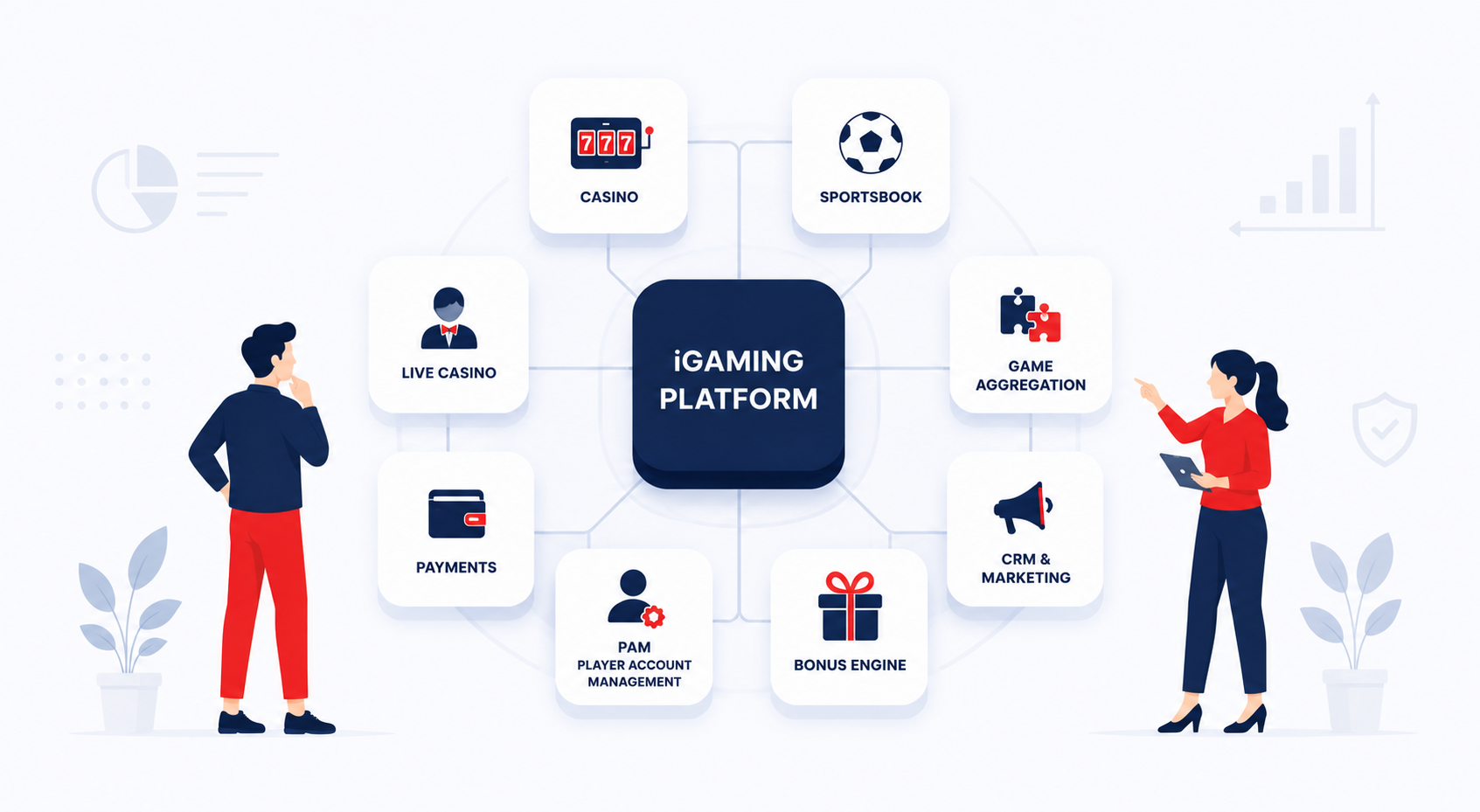
What Is an iGaming Platform?
Discover how player accounts, wallets, gaming products, payments and compliance tools operate within one connected technology infrastructure.
RNG-Based Online Scratch Cards
An RNG-based scratch card uses a Random Number Generator as part of the system responsible for producing game outcomes.
The game mathematics define the relationship between possible outcomes, prize values, game rules and the theoretical return. The RNG provides the random input used to select an outcome according to the certified game logic.
From the player’s perspective, the process remains simple. The player purchases or starts a card and reveals the result. Behind the interface, the gaming system must ensure that the outcome is generated, processed and recorded correctly.
RNG-based games require careful attention to:
- randomness and unpredictability,
- game mathematics,
- outcome mapping,
- prize tables,
- game rules,
- transaction recording,
- interruption handling,
- certification requirements.
Technical standards for interactive gaming systems can include requirements concerning RNGs, game outcomes, player accounts, transaction records and system controls. For example, GLI-19 provides a technical framework for evaluating interactive gaming systems, while regulated markets may impose additional local testing and certification requirements.
Certification in one market should not automatically be assumed to cover every other jurisdiction. Operators must confirm which standards, testing reports and certifications are accepted by the regulator in each target market.
What Are Emission-Based Scratch Cards?
An emission-based model works with a defined collection or issue of tickets and an associated prize distribution.
Rather than treating every game round purely as an independent random selection from the complete mathematical model, the system manages tickets or results within the configured emission structure.
The exact implementation can differ significantly between providers, lotteries and jurisdictions. Operators should therefore verify:
- how the ticket emission is created,
- how prizes are distributed within it,
- whether tickets are assigned randomly,
- how used and unused tickets are tracked,
- what happens when an emission ends,
- how the model is audited,
- which reports are available,
- how the implementation meets local requirements.
From the player’s perspective, an emission-based online card may look similar to an RNG-based card. Both can involve selecting a ticket, scratching digital areas and receiving an immediate result.
The difference exists primarily in the underlying game and prize-distribution model.
SYNOT Interactive’s current product materials reference support for both emission-based and RNG-based scratch cards, but the detailed implementation should always be confirmed for a specific operator project and target market.
RNG-Based vs Emission-Based Scratch Cards
The most suitable model depends on the operator, product strategy and regulatory environment.
| Area | RNG-Based Model | Emission-Based Model |
|---|---|---|
| Outcome model | Uses an RNG within the certified game logic | Uses a configured issue or collection of tickets |
| Prize distribution | Defined through game mathematics and outcome mapping | Defined within the structure of the emission |
| Inventory concept | Usually not presented as a finite ticket set | May involve tracking a defined set of tickets |
| Operational focus | RNG, mathematics, outcome handling and certification | Emission creation, ticket allocation, tracking and reporting |
| Player experience | Immediate digital result | Immediate digital result |
| Market suitability | Depends on certification and jurisdiction | Depends on implementation and jurisdiction |
This comparison is deliberately general. The precise architecture and regulatory treatment must be assessed for each product and jurisdiction.
Online Scratch Cards vs Traditional Scratch Cards
Online and physical scratch cards use a similar basic concept, but they operate through different distribution and technology environments.
| Traditional Scratch Cards | Online Scratch Cards |
|---|---|
| Printed physical ticket | Digital game interface |
| Purchased through retail distribution | Accessed through web, mobile or another digital channel |
| Scratched using a physical object | Revealed using mouse or touch controls |
| Physical prize validation process | Digital result and wallet processing |
| Limited after ticket production | Visuals and configurations may be adapted digitally |
| Physical inventory and distribution | Digital game and system integration |
| Retail reporting | Connected platform and BackOffice reporting |
The familiar scratch mechanic can make the transition from retail to online easier to understand from a product perspective. The digital format also gives operators more flexibility in presentation, device support, localization and integration with existing player accounts.
However, moving the format online involves more than reproducing the visual appearance of a paper ticket. The product must also handle player authentication, transactions, game logic, system communication, reporting and applicable regulatory controls.
Key Components of an Online Scratch Card Game
A complete online scratch card requires several connected components.
Game Logic
The game logic defines how the card operates.
It determines:
- which symbols can appear,
- which combinations produce a win,
- how bonus features are activated,
- how multipliers are applied,
- when a game round is complete,
- how the result is communicated.
The logic must match the published game rules and the certified mathematical model.
Prize Structure
The prize structure defines the relationship between stakes, possible outcomes and payouts.
Depending on the game, operators may work with:
- fixed ticket prices,
- multiple betting levels,
- different prize tiers,
- variable maximum prizes,
- bonus prizes,
- special multipliers.
Operators should verify which elements can be configured and which require a separate game version or certification.
Scratch Interface
The interface creates the recognizable scratch-card experience.
A digital scratch area should respond naturally to mouse and touchscreen movement. The information underneath should remain concealed until the player interacts with the card, while the final result must still be clearly displayed if the player does not reveal every part manually.
The interface may be supported by:
- animations,
- sound effects,
- visual feedback,
- automatic completion,
- reveal-all functionality,
- responsive layouts.
Accessibility and usability across different devices should form part of the design process.
Visual Theme and Branding
Scratch cards can use a wide range of themes, including:
- fantasy,
- adventure,
- sports,
- casino games,
- seasonal campaigns,
- traditional luck motifs,
- operator-specific branding.
The theme does not change the fundamental scratch mechanic, but it can help operators align specific games with campaigns, audiences or markets.
Custom cards can also use operator branding, market-specific visuals and localized content.
Bonus and Special Features
Digital scratch cards do not have to reproduce only the simplest physical ticket format.
Depending on the game design, they may include:
- win multipliers,
- re-spin options,
- special symbols,
- free games,
- bonus reveals,
- additional scratch areas,
- selectable numbers,
- more than one possible winning pattern.
These mechanics can add variety, but they must remain understandable. One of the main strengths of the category is its accessibility, so additional features should not make the game rules unnecessarily difficult to follow.
Player Wallet Integration
The wallet handles the financial side of gameplay.
It must process:
- ticket purchases or stakes,
- winnings,
- refunds or cancelled rounds,
- bonus balances where applicable,
- free-game transactions,
- transaction history.
Reliable real-time communication between the game and wallet is necessary to prevent discrepancies between gameplay and the displayed balance.
BackOffice and Reporting
Operator tools support the management and monitoring of the scratch card portfolio.
Depending on the solution, operators may require information about:
- game rounds,
- stakes,
- winnings,
- game performance,
- ticket or emission status,
- free games,
- bonus activity,
- currencies,
- markets,
- player activity,
- technical events.
The necessary level of reporting will depend on the operator’s internal processes and regulatory responsibilities.
What Is a Player Wallet in iGaming?
Learn how player wallets process stakes, winnings and financial transactions across connected casino products.

Generic vs Custom Online Scratch Cards
Operators may choose between generic and custom scratch card content.
Generic Scratch Cards
Generic scratch cards are developed as ready-made games that can be offered to multiple operators.
They may provide:
- faster implementation,
- established game logic,
- predefined visual themes,
- standard prize models,
- support for common bonus features,
- lower customization requirements.
Generic cards can be suitable for operators looking to expand their portfolio without commissioning a completely new game.
Custom Scratch Cards
Custom scratch cards are adapted or created for a particular operator, lottery, campaign or market.
Customization may include:
- visual identity,
- game theme,
- symbols,
- prize structure,
- betting levels,
- gameplay options,
- language,
- currency,
- bonus mechanics,
- market-specific requirements.
A custom project generally requires a more detailed definition of game rules, visuals, mathematics, integrations and certification scope.
The decision between generic and custom content should therefore consider the desired launch schedule, budget, differentiation requirements and market strategy.
How Do Online Scratch Cards Connect With an iGaming Platform?
A scratch card rarely operates as a completely isolated product.
The game may need to communicate with several parts of the wider iGaming ecosystem, including:
- Player Account Management,
- player wallets,
- authentication,
- bonus systems,
- responsible gaming controls,
- reporting,
- business intelligence,
- casino or lottery frontends,
- customer support tools.
A simplified process may look like this:

Player account → Wallet → Scratch card game → Game result → Wallet update → Reporting
The platform confirms the player session and makes the relevant balance available. The scratch card game processes the round and returns the result, while the connected iGaming platform infrastructure records the account, gameplay and reporting information.
This connection allows scratch cards to operate alongside other gaming verticals such as online casino, sportsbook, poker, lotteries and instant games.
Free Games and Promotional Use
Online scratch cards may also support play-for-free, demo or promotional mechanics.
A free game can allow a player to experience the format without placing a real-money stake. Depending on the operator’s implementation, free-game functionality may be used for:
- product onboarding,
- game discovery,
- promotional campaigns,
- player reactivation,
- bonus rewards,
- selected CRM activities.
Free and real-money gameplay should always be clearly distinguished. Operators must also ensure that promotional mechanics, player communication and game availability remain consistent with applicable consumer-protection and responsible gaming requirements.
In regulated markets, operators must also ensure that free-to-play versions follow applicable requirements. For example, the UK Gambling Commission’s Remote Gambling and Software Technical Standards include requirements covering result determination for play-for-free games as well as the generation of random outcomes.
What Should Operators Look for in an Online Scratch Card Solution?
Operators should evaluate more than the number of available card designs. The scratch card solution must fit the operator’s platform architecture, target markets, certification requirements and long-term content strategy. The same principles apply when choosing an iGaming platform provider for a wider technology project.
The most suitable solution must fit the operator’s technical environment, target markets and product strategy.
Game and Outcome Model
Operators should establish:
- whether the card is RNG-based or emission-based,
- how the outcome model works,
- how prize distribution is configured,
- which mathematical documentation is available,
- which testing and certifications have been completed.
Integration Requirements
The provider should explain how the scratch card product connects with:
- the operator’s platform,
- PAM,
- player wallet,
- bonus system,
- frontend,
- reporting environment.
The operator should also understand which technical resources are required from both sides during integration.
Device Compatibility
Scratch cards should work consistently across supported devices.
Operators should evaluate:
- desktop performance,
- mobile performance,
- tablet support,
- portrait and landscape layouts,
- mouse controls,
- touchscreen gestures,
- loading times,
- behaviour after connection interruptions.
A strong desktop experience does not automatically guarantee equally good mobile usability.
Localization
For operators active in multiple markets, localization may include:
- language,
- currency,
- game rules,
- stake levels,
- theme,
- legal information,
- responsible gaming content.
The operator should clarify which elements can be modified through configuration and which require a new game version.
Operator Controls
A BackOffice should provide the level of control required by the operator.
Relevant questions include:
- Can games be enabled or disabled by market?
- Can stake levels be configured?
- Which reports are available?
- How are bonus and free-game features managed?
- Can performance be reviewed by game, market or currency?
- How are access rights managed?
- Which changes require provider support?
Compliance and Certification
Before launch, the operator should verify whether the games and system meet the requirements of the target jurisdiction.
This may include evaluation of:
- RNG functionality,
- game mathematics,
- displayed rules,
- transaction handling,
- logging,
- player records,
- interrupted games,
- security controls,
- play-for-free behaviour,
- responsible gaming requirements.
Compliance should be assessed for the actual market and implementation rather than treated as a generic product label.
Customization
Operators looking for differentiated content should confirm what can be customized.
This may include:
- visual theme,
- operator branding,
- symbols,
- animations,
- sounds,
- betting levels,
- prize configuration,
- bonus mechanics,
- language and currency options.
Customization must remain consistent with the approved game logic and certification scope.
Why Add Scratch Cards to an Online Casino Portfolio?
Scratch cards can complement more complex casino products because a typical game round requires limited player input and delivers an immediate result. Operators starting an online casino can therefore consider scratch cards as one part of a broader content and product strategy rather than as an isolated vertical.
The category can complement more complex products because a typical game round requires limited player input. The player selects a card, starts the game, reveals the covered areas and receives an immediate result.
From a portfolio perspective, online scratch cards can provide:
- a familiar instant-win format,
- relatively short game rounds,
- straightforward interaction,
- different visual themes,
- mobile-friendly gameplay,
- a bridge between retail and online gaming,
- additional promotional options,
- custom branding opportunities.
Depending on the operator’s technology setup, scratch cards may be integrated directly or delivered alongside other casino content. Operators using game aggregation technology should clarify whether scratch card content, reporting and promotional mechanics can be managed through the same integration environment.
Online Scratch Cards With SYNOT Interactive
SYNOT Interactive provides both generic and customizable online scratch card content for casino and lottery operators.
The available solution supports a range of themes, flexible gameplay options and a realistic scratch-off experience across desktop, mobile and tablet devices.
Depending on the project, the scratch card portfolio can include:
- generic scratch card games,
- custom scratch cards,
- RNG-based or emission-based models,
- different betting levels and prize structures,
- game-specific bonus features,
- win multipliers,
- re-spin mechanics,
- special symbols,
- free-game functionality,
- operator BackOffice tools,
- support for multiple currencies and languages.
The final configuration depends on the operator’s existing infrastructure, target market and commercial requirements.
Looking for an Online Scratch Card Solution?
Add customizable online scratch cards to your casino or lottery portfolio with flexible game mechanics, operator tools and support across multiple devices.
Explore the SYNOT Interactive Scratch Cards solution and discuss the most suitable integration model for your business.
Final Thoughts
Online scratch cards transfer a widely recognized physical game concept into a digital gaming environment.
The visible scratch interaction may appear simple, but a complete solution requires reliable game logic, outcome management, wallet communication, responsive design, reporting and appropriate certification.
Operators should pay particular attention to the underlying outcome model, prize configuration, integration architecture, device compatibility and regulatory suitability.
The strongest solution is not necessarily the one with the greatest number of visual themes. It is the one that combines understandable gameplay with reliable technology, transparent rules and the flexibility required by the operator’s target markets.
FAQ About Online Scratch Cards
Online scratch cards are digital instant-win games inspired by traditional paper scratch tickets. Players use a mouse or touchscreen to reveal concealed symbols, numbers or prize combinations through an online casino, lottery platform or mobile application.
A player selects a card, purchases a ticket or places a stake and interacts with the digital scratch area. The underlying game system determines or allocates the outcome, evaluates the revealed combination and credits any applicable winnings to the connected player wallet.
Some online scratch cards use a Random Number Generator as part of the game system responsible for producing outcomes. Other products may use an emission-based model built around a defined issue or collection of tickets. The exact model depends on the game, provider and jurisdiction.
Physical scratch cards are printed tickets distributed through retail channels. Online scratch cards are accessed digitally and use a mouse or touchscreen to simulate the scratch interaction. Digital games can also connect directly with player accounts, wallets, bonus systems and operator reporting tools.
An emission-based scratch card operates with a configured ticket issue and associated prize distribution. The system manages the allocation, use and reporting of tickets within that emission. The detailed implementation can vary between providers and jurisdictions.