


What Is a Casino Management System and How Does It Work?

A Casino Management System (CMS) is a software platform used by land-based casinos and gaming halls to monitor, manage and optimise their day-to-day operations.
A modern casino management system can connect gaming machines, player data, financial records, jackpots, floor operations, reporting tools and other casino systems within one central environment.
For operators, this means having a clearer overview of what is happening across the gaming floor and being able to make operational decisions based on real-time or near-real-time data.
Casino management systems can support areas such as:
- gaming machine monitoring
- casino floor management
- jackpot management
- player tracking
- financial reporting
- TITO and cashless systems
- marketing campaigns
- multi-location management
- operational analytics
- integrations with casino hardware
This guide explains what a casino management system is, how it works and which functions operators should consider when evaluating casino management software.
How Does a Casino Management System Work?
A casino management system connects different parts of a land-based gaming operation and brings their data into one central management environment.
At a simplified level, the process can look like this:
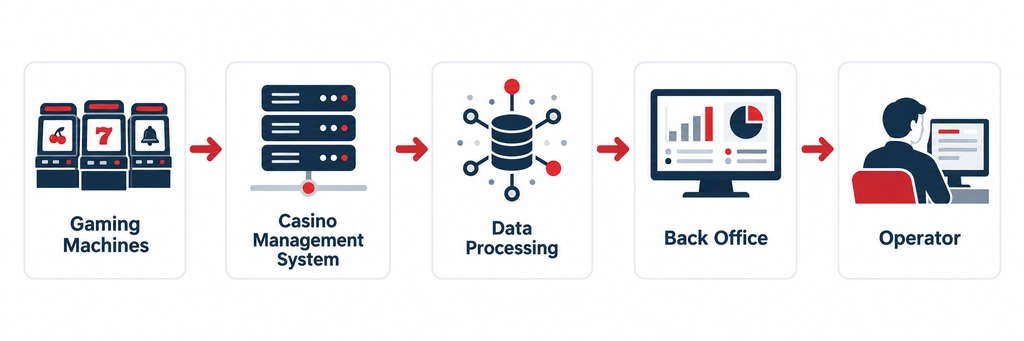
Gaming Machines → Casino Management System → Data Processing → Back Office → Operator
Gaming machines and connected systems continuously generate operational data.
Depending on the setup, this can include:
- machine status
- game activity
- financial meter data
- player sessions
- jackpot information
- transaction records
- machine performance
- operational events
The casino management system collects and processes this information before presenting it through dashboards, reports or other back-office tools.
This allows operators to monitor the casino floor without relying entirely on manual checks.
Monitoring and control systems have long been used in regulated casino environments to collect device data, record significant events and support reporting and reconciliation. Gaming Laboratories International, for example, defines casino monitoring and control systems as technology that continuously communicates with electronic gaming devices and collects operational and financial information.
What Does a Casino Management System Manage?
A modern casino management system may support several areas of casino operations.
| Area | What It Manages |
|---|---|
| Gaming Machines | Machine status, activity, performance and operational data |
| Casino Floor | Machine placement, venue layout and floor visibility |
| Players | Player activity, sessions and related account information |
| Jackpots | Jackpot configuration, monitoring and performance |
| Transactions | Financial and operational transaction records |
| Reporting | Revenue, performance and operational insights |
| Marketing | Promotions, campaigns and player engagement |
| Multi-Location Operations | Centralised visibility across multiple gaming venues |
The exact functionality depends on the system, operator requirements and local regulatory environment.
Some casino management systems focus mainly on machine monitoring, while more comprehensive platforms combine operational, financial, player and marketing functionality.
Core Components of a Casino Management System
A casino management system usually consists of several interconnected components.
Gaming Machine Management
Gaming machine management gives operators visibility into connected gaming devices.
The system can help monitor:
- machine status
- activity levels
- revenue performance
- player sessions
- operational events
- machine availability
This information can help operators understand how individual machines are performing and identify areas that may require attention.
For operators managing hundreds or thousands of machines, centralised monitoring can significantly reduce the amount of manual control required across the gaming floor.
Casino Floor Management
Casino floor management gives operators a visual overview of how gaming machines are distributed across a venue.
A floorplan interface can display the location and status of individual machines and help operators analyse how different areas of the casino are performing.
Operators can use this information to evaluate:
- machine placement
- floor utilisation
- occupancy
- gaming performance
- player movement
- operational bottlenecks
Interactive floorplans can also make day-to-day management easier by providing a visual representation of the gaming floor instead of relying only on numerical reports.
SYNNET, for example, includes real-time floorplan visualisation with machine performance and operational data.
Jackpot Management
Jackpots can be an important part of land-based casino operations.
A casino management system may allow operators to configure and monitor jackpot systems across individual machines, groups of machines or entire gaming networks.
Depending on the technology, operators may manage:
- local jackpots
- progressive jackpots
- mystery jackpots
- promotional jackpots
- jackpot contribution settings
- payout configurations
- jackpot performance
Centralised jackpot management can make it easier to control jackpot activity across multiple gaming devices or venues.
Player Tracking
Player tracking helps operators understand how registered players interact with the casino environment.
Depending on the system and regulatory requirements, operators may be able to analyse information such as:
- gaming sessions
- machine usage
- visit frequency
- player activity
- transaction history
- loyalty activity
This information can support operational analysis, player service and marketing activities.
Player tracking should always be implemented in accordance with applicable privacy, data-protection and gaming regulations.
Reporting and Analytics
Reporting is one of the most important functions of a casino management system.
Operators need reliable information about what is happening across their venues.
Casino management reports may include:
- machine performance
- revenue
- payouts
- jackpot activity
- transaction history
- player activity
- venue performance
- operational trends
Instead of collecting information manually from individual machines or systems, operators can use the CMS as a central source of operational data.
This can make it easier to identify trends, compare performance and support management decisions.
Marketing and Campaign Management
Some casino management systems also include tools for managing promotional activity.
Operators may use these tools to create or support:
- player promotions
- loyalty campaigns
- venue-specific offers
- jackpot campaigns
- targeted player communication
When marketing functionality is connected with player activity and casino data, operators can create more targeted campaigns based on actual behaviour.
Multi-Location Management
Casino operators often manage more than one gaming venue.
A casino management system can provide a centralised view of multiple locations from one management environment.
Operators may be able to compare:
- revenue by venue
- machine performance
- operational status
- player activity
- jackpot performance
- campaign results
This is particularly useful for operators managing gaming halls or casino networks across different cities or regions.
What Is PAM in iGaming?
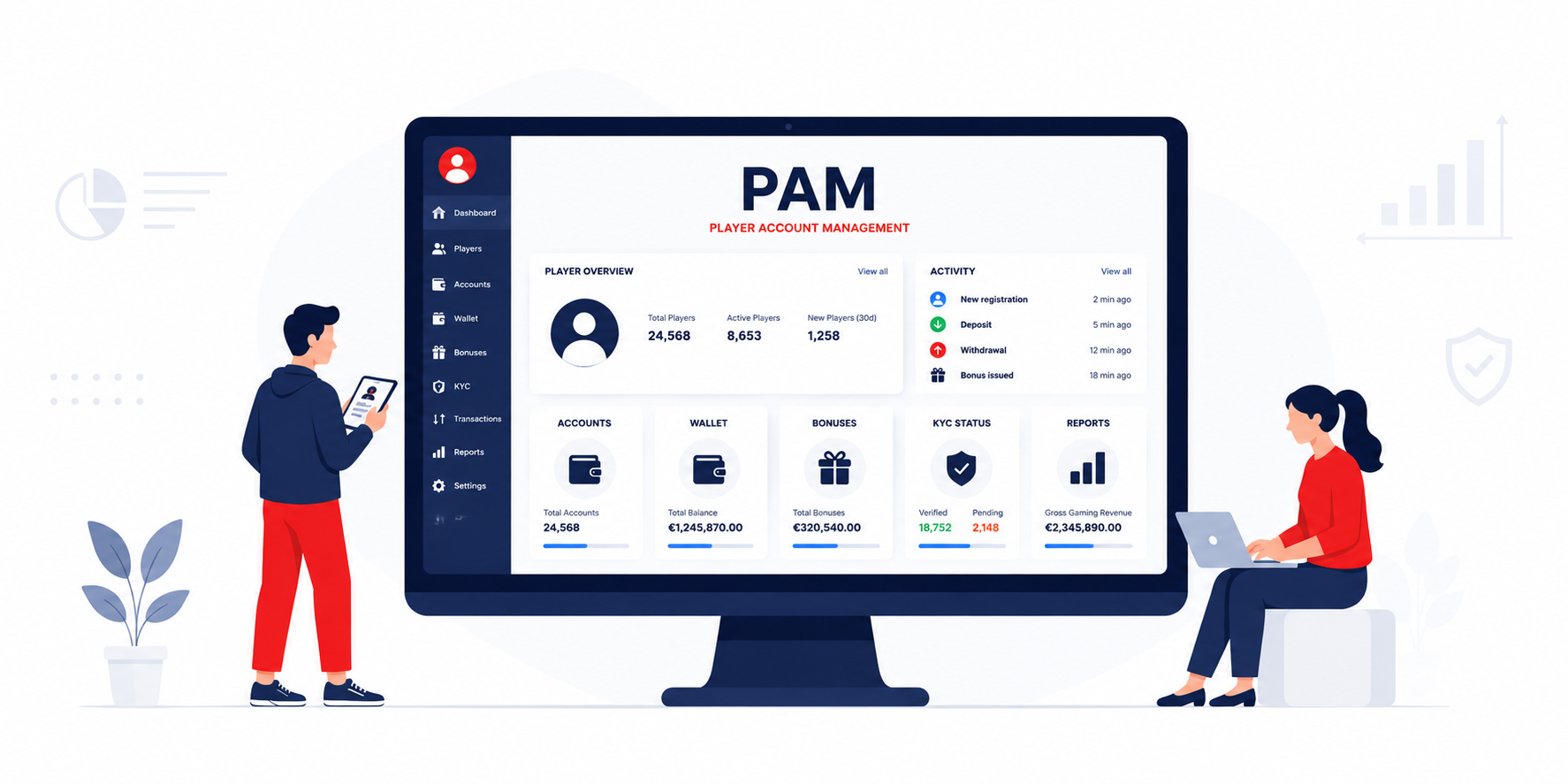
While game aggregation connects operators with content providers, PAM systems manage player accounts, wallets, bonuses, and regulatory requirements.
What Is Casino Floor Management?
Casino floor management is the process of organising, monitoring and optimising gaming machines and other operational areas within a casino or gaming hall.
A digital casino floor management system can provide operators with a real-time visual representation of the venue.
Instead of relying only on spreadsheets or physical inspections, operators can see where machines are located and how they are performing.
A casino floor management system may support:
- drag-and-drop machine placement
- machine status monitoring
- profitability analysis
- occupancy tracking
- player-session visibility
- jackpot history
- operational alerts
Floor management can therefore help operators understand not only how individual machines perform, but also how the layout of the gaming floor affects overall operations.
How Does Casino Management Reporting Work?
Casino management reporting transforms operational data into information that casino teams can use.
Data can be collected from gaming machines, financial systems, player systems and other connected technologies.
The CMS then processes this information and makes it available through dashboards or reports.
For example, an operator may want to know:
- Which gaming machines generate the most revenue?
- Which machines are underperforming?
- Which venue performs best?
- How have jackpot payouts changed?
- Which parts of the gaming floor have the highest activity?
- How much money moved through the system during a specific period?
Having this information available in one environment can reduce manual reporting and help operators make faster decisions.
What Is TITO in a Casino Management System?
TITO stands for Ticket-In, Ticket-Out.
It is a system that allows players to transfer monetary value through printed or digital tickets instead of relying only on coins or cash.
For example, when a player finishes playing on a gaming machine, the machine may issue a ticket containing the remaining balance.
The player can then:
- insert the ticket into another compatible gaming machine,
- redeem it at a cashier,
- or use a supported redemption machine.
TITO systems help simplify movement of funds across a casino floor and can reduce the need for physical cash handling.
Casino monitoring environments may also record and manage TITO-related transactions.
Nevada gaming standards, for example, explicitly recognise Ticket-In, Ticket-Out redemption machines as part of regulated casino operations.
What Is the Difference Between TITO and Cashless Casino Systems?
TITO and cashless systems both reduce the need for physical coins, but they work differently.
TITO uses a ticket or voucher that represents monetary value.
Cashless casino systems may allow value to move electronically through player accounts, cards, mobile applications or other digital systems.
A casino management system may support one or both approaches depending on the operator and jurisdiction.
Cashless casino technologies are also covered by dedicated industry standards, including GLI-16.
Casino Management System vs iGaming Platform
Casino management systems and iGaming platforms both manage gaming operations, but they are designed for different environments.
| Casino Management System | iGaming Platform |
|---|---|
| Primarily focused on land-based gaming | Primarily focused on online gaming |
| Manages gaming machines and venues | Manages digital gaming products |
| Supports casino floor operations | Supports online casino, sportsbook, poker and other verticals |
| Uses machine and venue data | Uses player, wallet and platform data |
| Can connect physical casino locations | Operates across digital channels |
| Supports hardware integrations | Primarily uses software and API integrations |
An iGaming platform typically manages online player accounts, payments, games and digital products.
A casino management system focuses primarily on the physical gaming environment.
Some operators may use both systems, particularly when combining online and land-based operations.
Casino Management System vs Player Account Management
A Casino Management System should also not be confused with a Player Account Management system.
A Player Account Management system focuses mainly on the relationship between an operator and an individual player.
PAM may manage:
- registration
- account information
- identity
- wallet
- KYC
- responsible gaming
- account status
A Casino Management System focuses more broadly on the operational environment of land-based casinos and gaming halls.
The two systems can still be connected, especially in omnichannel gaming environments.
Why Is a Casino Management System Important for Operators?
Managing a land-based casino involves many connected processes.
Operators need to monitor gaming machines, financial activity, player behaviour, jackpots, reporting and venue performance.
Without a central management system, this information may be distributed across several separate systems or require significant manual work.
A modern casino management system can help operators achieve:
- better operational visibility
- centralised management
- faster access to data
- more consistent reporting
- easier multi-location control
- improved machine-performance analysis
- more efficient casino floor management
- simpler system administration
The main advantage is not simply collecting more data.
It is giving operators a clearer understanding of how their gaming operation is performing.
What Should Operators Look for in a Casino Management System?
Choosing a casino management system involves more than comparing feature lists.
Operators should evaluate how well the technology fits their existing gaming environment, operational processes and future growth plans.
| Area | What Operators Should Consider |
|---|---|
| Real-Time Data | How quickly operational information becomes available |
| Scalability | Whether the system can support additional machines and venues |
| Reporting | Quality of financial and operational insights |
| Floor Management | Visibility and control of gaming-floor operations |
| Integration | Compatibility with gaming machines and third-party hardware |
| Security | Protection of operational and transaction data |
| Customisation | Ability to adapt the system to operator-specific workflows |
| Multi-Site Support | Central management across multiple locations |
| Regulatory Adaptability | Ability to meet market-specific requirements |
| Support & Maintenance | Availability of ongoing technical assistance |
The relative importance of each area depends on the operator.
A small gaming venue may primarily require simple monitoring and reporting, while a multi-location operator may prioritise scalability, centralised management and geographic performance comparisons.
How Does a Casino Management System Integrate With Hardware?
Land-based casino environments depend on both software and physical hardware.
Casino management systems therefore often need to communicate with multiple types of devices.
These may include:
- gaming machines
- card readers
- printers
- scanners
- cash-handling systems
- ticketing systems
- cameras
- kiosks
- other casino hardware
Compatibility and integration are therefore important considerations when selecting a CMS.
A system that can connect easily with existing hardware can reduce implementation complexity and help operators avoid unnecessary infrastructure changes.
Security and Casino Management Systems
Casino management systems handle operational and financial information, which makes security an important requirement.
Operators should consider areas such as:
- access control
- user permissions
- transaction integrity
- system availability
- secure communication
- data protection
- audit history
- monitoring
The exact requirements will vary between jurisdictions.
For regulated casino operations, CMS implementation may also need to meet local technical standards, certification requirements or regulator-specific controls.
Casino Management System With SYNNET
SYNNET is the Casino Management System developed by SYNOT Interactive for land-based casinos and gaming halls.
The platform provides operators with a central environment for monitoring and managing casino operations.
SYNNET currently includes functionality such as:
- real-time operational dashboards
- gaming machine monitoring
- interactive floorplan visualisation
- jackpot management
- geographic mapping
- TITO
- cashless functionality
- player tracking
- marketing tools
- reporting and analytics
- hardware integration
- multi-location management
The system is designed to be scalable and configurable according to the requirements of individual operators and markets.
Explore the SYNNET Casino Management System
Casino Management System in Production
SYNNET is already operating in live casino environments.
In March 2025, SYNOT Interactive launched the system across the Joker.lv gaming-hall network in Latvia. The deployment was designed to centralise operational control and support more efficient management across the network.
Real-world deployments are particularly important when evaluating casino management technology because operators need systems that can handle live gaming operations, connected machines and daily operational workloads.
Read more about the SYNNET deployment in Latvia
The Future of Casino Management Systems
Casino management systems are increasingly becoming data-driven operational platforms rather than simple machine-monitoring tools.
Future development is likely to continue in areas such as:
- real-time reporting
- cashless gaming
- centralised multi-location management
- mobile operational access
- better hardware integration
- automated monitoring
- more advanced analytics
- improved player tracking
- more flexible regulatory configuration
The direction is clear: casino operators increasingly need centralised access to operational information across both machines and venues.
Systems that can convert this data into clear operational insight can help operators manage increasingly complex casino environments more efficiently.
Final Thoughts
A Casino Management System is one of the central technologies behind modern land-based casino operations.
It connects gaming machines, financial information, player activity, jackpots, floor operations, reporting and other casino systems into one management environment.
For operators, the value of a CMS lies in visibility and control.
Rather than managing each machine, venue or operational process separately, a casino management system creates a central source of information that can support daily operations, reporting and long-term decision-making.
When evaluating casino management software, operators should therefore consider not only individual features, but also scalability, integration, reporting, security and the ability to support future expansion.
FAQ About Casino Management System
A casino management system is software used to monitor and manage land-based casino operations, including gaming machines, player activity, jackpots, transactions, reporting and casino-floor operations.
A casino management system collects operational data from gaming machines and connected systems. It processes this information and makes it available through dashboards, reporting tools and back-office applications.
A casino management system can manage gaming machines, casino floors, players, jackpots, financial records, reporting, marketing campaigns and multi-location operations.
Casino floor management involves monitoring and organising gaming machines and other operational areas within a casino. Digital floor-management tools can display machine locations, status and performance through an interactive floorplan.
SYNNET is the Casino Management System developed by SYNOT Interactive for managing land-based casinos and gaming halls. It includes tools for real-time monitoring, floorplan management, jackpots, reporting, TITO, cashless operations, player tracking and multi-location management.